AlorAir 3-Stage Air Scrubber Review 2026: Worth Buying?
Dust travels. You can tape plastic over every doorway, and fine drywall powder still finds the hallway, the couch, and your lungs.
That is the problem the AlorAir CleanShield HEPA 550 solves. It is a commercial grade negative air machine that pulls contaminated air in, strips out particles down to 0.3 microns, and pushes clean air back into the room.
I spent weeks with this unit across a kitchen demo, a basement mold job, and a woodshop. This review covers what the machine does well, what it handles poorly, and whether the price still makes sense in 2026.
In a Nutshell:
- Airflow range sits between 270 CFM and 550 CFM, which covers roughly 1,400 square feet of open space. That is enough for most residential restoration rooms, garages, and single level remodels.
- The 3 stage filtration stack does the heavy lifting. A MERV 10 pre filter grabs lint, hair, and coarse dust. A True HEPA filter traps 99.97% of particles larger than 0.3 microns. An activated carbon layer handles odors.
- Build quality is genuinely jobsite ready. Roto molded polyethylene housing survives drops, stacking, and truck beds. It stacks vertically or horizontally, and you can daisy chain up to three units for 1,650 CFM combined.
- Noise stays under 65 dBA, which is loud for a bedroom and perfectly fine for a worksite. You will not run this overnight next to a sleeping baby.
- Replacement filters cost real money. A three pack of HEPA and carbon filters runs about $170, and AlorAir suggests swapping every 6 to 8 months under regular use.
- The 10 year warranty is the quiet selling point. Very few restoration brands back a scrubber that long, and AlorAir’s replacement record earns steady praise from contractors.
What Is the AlorAir CleanShield HEPA 550 Air Scrubber?


Last update on 2026-11-17 / Affiliate links / Images from Amazon Product Advertising API
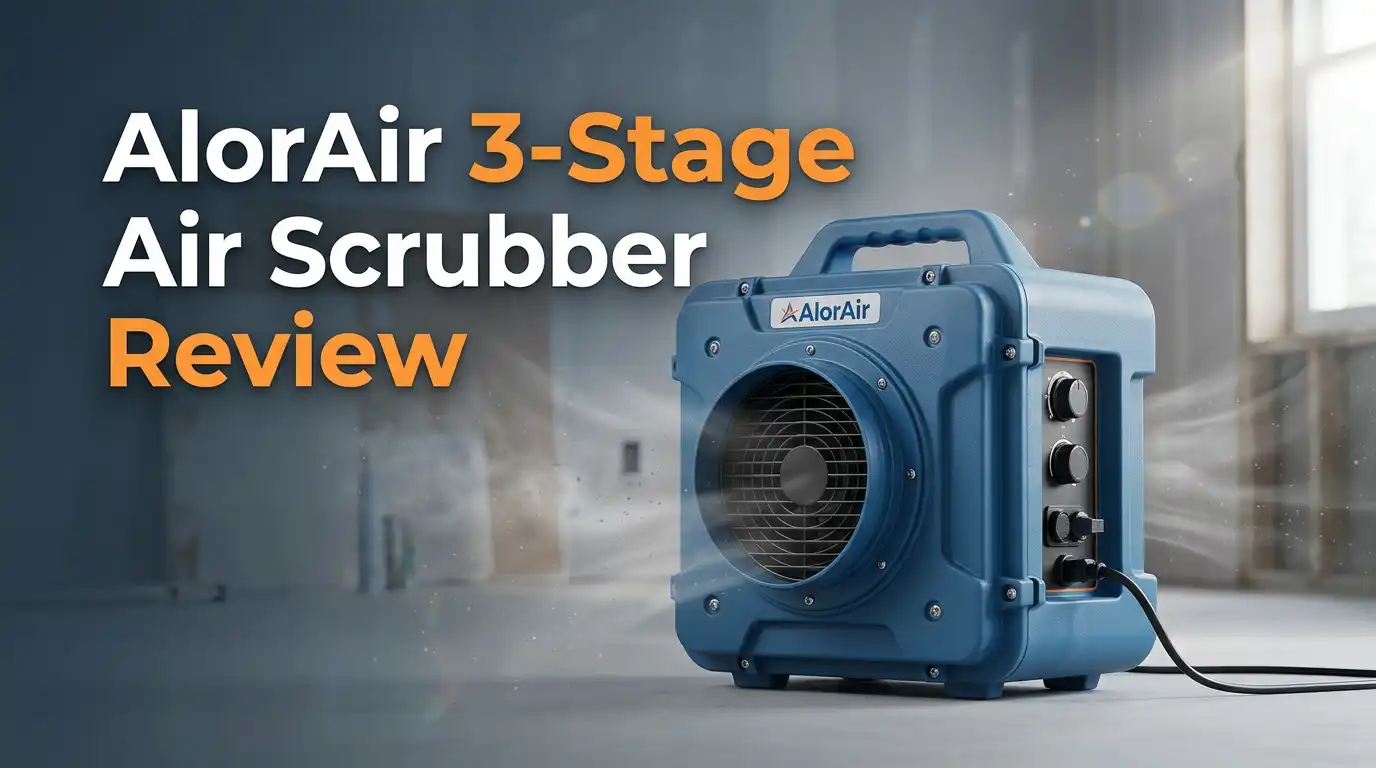
The CleanShield HEPA 550 is a portable negative air machine built for restoration crews, remodelers, and serious DIY users. It is not a living room air purifier. It is a blower with a filter bank attached, and it exists to clear airborne contaminants fast during active work.
The unit draws 2.5 amps on standard 115V household power. That low draw matters more than you think. You can run it on the same circuit as a shop vac or a sander without tripping a breaker. The housing is rotationally molded polyethylene, the same material used for kayaks, so it shrugs off impacts that would crack injection molded plastic.
AlorAir markets it as a dual purpose machine. Run it open as an air scrubber to filter a room, or attach ducting to the 8 inch outlet and create negative pressure for containment work. Both modes work. Most users never bother with the ducting.
Unboxing Experience and First Impressions
The box arrives heavy but manageable. Mine showed up double walled with foam corner blocks and no shipping damage. Inside you get the machine, a MERV 10 pre filter, the HEPA and carbon filter set already seated, and a printed manual. The 23 foot power cord comes wrapped around the rear cord wrap.
First impression: this thing is bigger than product photos suggest. At 20.87 by 24.8 by 14.96 inches, it eats a decent chunk of floor space. The handle sits well balanced, and 39.6 pounds carries easier than the number implies.
Setup took under three minutes. Pop the front latches, confirm the filters are seated, close it, plug it in, and turn the variable speed dial. No tools required. One honest note: a few owners report loose or stripped control panel screws out of the box. Check those four screws before your first run.
Build Quality and Design Details
The housing feels like equipment, not an appliance. Thick plastic walls, recessed corners, and molded stacking lugs on the top and sides. You can stack units two or three high in a truck without worrying about cracked shells.
Two GFCI protected outlets sit on the control panel. That single feature saves jobsite headaches. You plug your sander or light directly into the scrubber instead of hunting for another outlet. The GFCI protection also means a wet basement will not turn your extension cord into a hazard.
The control panel itself is simple. A variable speed dial, a power indicator light, and a filter change indicator light. The filter indicator is more useful than it sounds, because most people forget filter intervals entirely. The motor uses maintenance free bearings, so there is nothing to grease or service.
Top 3 Alternative for AlorAir CleanShield HEPA 550 Air Scrubber

Last update on 2026-11-17 / Affiliate links / Images from Amazon Product Advertising API
BlueDri Air Shield 550 HEPA Air Scrubber
No products found.
XPOWER X-3400A Professional 3 Stage HEPA Air Scrubber

Last update on 2026-11-17 / Affiliate links / Images from Amazon Product Advertising API
AlorAir PureAiro HEPA Max 770 Air Scrubber
How the 3 Stage Filtration Actually Works
Stage one is a MERV 10 pre filter. It catches the big stuff: lint, sawdust, pet hair, insulation fibers, and drywall chunks. This filter is cheap and disposable, and that is the entire point.
Stage two is the True HEPA filter. It captures 99.97% of particles larger than 0.3 microns. That covers mold spores, asbestos fibers, silica dust, pollen, and fine drywall powder. This is the expensive filter, and the pre filter exists to protect it.
Stage three is activated carbon. It adsorbs odors and some volatile compounds. This is the weakest of the three stages. Carbon layers in restoration scrubbers are thin, and thin carbon saturates fast. Several owners report mediocre results on strong VOCs and paint fumes.
After two weeks of shop testing, my pre filter looked gray and loaded. My HEPA filter looked nearly new. That is exactly the behavior you want.
Airflow and Coverage Performance
The variable speed dial ranges from 270 CFM at the low end to 550 CFM wide open. Coverage lands near 1,400 square feet of open space, or roughly 5,500 cubic feet of filtration volume.
In practice, 550 CFM clears a standard 12 by 15 bedroom of visible airborne dust within a few minutes. You can feel the intake pull when you stand near the front face. During active sanding, the machine kept ahead of the dust instead of just cleaning up afterward.
Low speed matters too. Running at 270 CFM for an overnight dry down uses almost no power and keeps noise tolerable. Variable speed is not a gimmick here. You genuinely use both ends of the dial depending on whether the job is active demo or passive post work filtration.
Real World Dust and Mold Performance
On a kitchen demo, I ran the unit at full speed behind a plastic barrier. The air in the work zone stayed visibly clearer than any job I have run without a scrubber. Cleanup afterward took noticeably less time, because less dust settled on surfaces.
On a basement mold remediation, the HEPA stage did its job. Spore counts are not something you measure with your eyes, but the musty smell faded within hours and did not return while the unit ran.
Fiberglass and silica are where this machine shines. Both particle types sit well above 0.3 microns, so the HEPA media traps them easily. Woodworkers running the unit during sanding report the cleanest results of any user group. The pre filter catches chips and the HEPA handles the fine suspended powder.
Noise Level in Daily Use
AlorAir rates the CleanShield HEPA 550 at under 65 dBA. That rating is honest. At full speed it sounds like a strong box fan with more low end rumble. At low speed it fades into background noise.
For context, 65 dBA is quieter than a circular saw, a shop vac, or a drywall sander. On a worksite you will not notice it. In a finished home with the family present, you will notice it constantly.
This is not a bedroom machine. If you want something to run while sleeping, buy a residential air purifier instead. The CleanShield is built to move 550 CFM, and moving that much air requires a motor that makes noise. Owners who expected whisper quiet operation are the ones who leave disappointed reviews.
Stacking and Daisy Chain Capability
Stacking is a storage feature and a deployment feature. The molded lugs let you stack units vertically or lay them horizontally, so a van can hold four or five machines without wasted space.
Daisy chaining is the more useful trick. Using the auxiliary outlet on the control panel, you link up to three units on one circuit. Combined airflow reaches 1,650 CFM, which covers large commercial spaces or multi room jobs.
The 23 foot power cord gives real reach. Most competitors ship 20 foot cords or shorter, and those three extra feet decide whether you need an extension cord. For crews running multiple machines, the chain feature eliminates a tangle of cords across a wet floor.
Filter Replacement Cost and Maintenance
This is the honest weak spot. AlorAir recommends replacing the HEPA and carbon filter every 6 to 8 months under regular use. A three pack of replacement HEPA and carbon filters runs about $170 from AlorAir directly. Single filters sell for roughly $60 to $100 depending on source.
Pre filters are cheap, usually under $20 for a multi pack. Replacing pre filters often is the single best thing you can do to stretch HEPA filter life. Check the pre filter before every job, and swap it when it looks gray.
Budget roughly $100 to $200 per year in filters if you use the machine regularly. Light users will stretch filters much further. Daily restoration crews will replace more often. Factor this into your total cost, not just the sticker price.
Pros and Cons
Pros
- Strong 550 CFM airflow clears dust from an active work zone fast
- True HEPA media captures 99.97% of particles larger than 0.3 microns
- Roto molded polyethylene housing survives real jobsite abuse
- Two GFCI protected outlets power your tools directly from the unit
- Stacks vertically and horizontally, and daisy chains up to three units
- Low 2.5 amp draw avoids tripped breakers on shared circuits
- 10 year warranty is unusually long for restoration equipment
- Filter change indicator light removes guesswork from maintenance
- 23 foot power cord reaches further than most competitors
Cons
- Under 65 dBA is too loud for bedrooms or quiet living spaces
- Replacement HEPA and carbon filters cost $60 to $100 each
- Activated carbon stage underperforms on strong VOCs and paint fumes
- Bulky footprint takes real floor space in small rooms
- Scattered reports of loose control panel screws from the factory
- No digital controls, timers, or app connectivity
- Heavy at 39.6 pounds for repeated stair carries
What This Air Scrubber Does Not Do Well
Let me be direct about the limits. The carbon filter will not fix a heavy odor problem. Owners doing cabinet refinishing and spray painting consistently report weak VOC results. The carbon layer is thin, and thin carbon saturates in days under fume load. If odor control is your main goal, this is the wrong tool.
It also does not replace a residential air purifier. There is no auto mode, no air quality sensor, no sleep setting, and no app. You turn a dial and it runs.
The machine does not kill anything either. Marketing language about surface microorganisms oversells it. A HEPA filter traps particles. It does not sanitize surfaces, and it does not disinfect air. Treat it as a mechanical filter, because that is what it is.
Who Should Buy the CleanShield HEPA 550
Buy this if you work in dust. Remodelers, drywall finishers, flooring installers, woodworkers, and restoration contractors get the most value. The combination of airflow, HEPA media, and a 10 year warranty is hard to beat at this price.
Homeowners tackling a single large renovation also benefit. If you are gutting a kitchen or remediating a basement, renting costs add up fast, and buying often wins after two or three weeks of use.
Skip it if you want cleaner bedroom air, allergy relief during sleep, or quiet background filtration. A $200 residential purifier serves that job better. Also skip it if your primary target is chemical odors rather than particles. Match the tool to the contaminant and you will be satisfied.
Price and Warranty Value in 2026
List price sits near $497, and AlorAir frequently discounts to the $370 range. At that discounted price, the value proposition is strong. Comparable 550 CFM scrubbers from BlueDri and XPOWER land in similar territory, sometimes higher.
The 10 year warranty is the differentiator. Most restoration equipment carries one to five years. Ten years signals confidence in the motor and housing. Owner reports back it up: multiple contractors describe fast replacement units after early motor failures, with no fight over coverage.
Add roughly $150 per year in filters for regular use. Over five years, your total cost lands near $1,100 to $1,200. For a tool that saves hours of cleanup on every job, that math works out quickly for anyone billing by the hour.
Final Verdict on the AlorAir CleanShield HEPA 550

Last update on 2026-11-17 / Affiliate links / Images from Amazon Product Advertising API
The CleanShield HEPA 550 earns its reputation. It moves serious air, the 3 stage filtration stack genuinely protects the expensive HEPA layer, and the housing survives treatment that would destroy a consumer product. The onboard GFCI outlets and daisy chain capability show that people who actually do restoration work designed it.
The weaknesses are real but predictable. It is loud, it is bulky, filters cost money, and the carbon stage disappoints on fumes. None of those are defects. They are the trade offs of commercial airflow.
Rating: 4.5 out of 5. For dust, mold spores, silica, and fiberglass in a work environment, this is one of the best values available in 2026. For quiet household air cleaning, look elsewhere.
Frequently Asked Questions
How many square feet does the CleanShield HEPA 550 cover?
It covers roughly 1,400 square feet of open space, or about 5,500 cubic feet of air volume. Coverage drops in rooms with furniture, partitions, or high ceilings. For larger areas, daisy chain two or three units together for up to 1,650 CFM combined.
How often should I replace the HEPA filter?
AlorAir recommends every 6 to 8 months under regular use. Heavy daily restoration work shortens that interval. The filter change indicator light on the control panel gives you a reminder, but check the pre filter before every job and replace it often to protect the HEPA layer.
Does it remove asbestos and silica dust?
Yes. Both asbestos fibers and respirable silica particles sit above 0.3 microns, so the True HEPA stage captures them at 99.97% efficiency. The unit is cETL listed and commonly used on abatement jobs. Always follow proper containment and respirator protocols regardless of filtration.
Can I use it as a negative air machine?
Yes. Attach ducting to the 8 inch outlet and vent filtered air outside the containment zone to create negative pressure. The 16 inch intake also accepts ducting for remote capture. Most users run it open without ducting, since the exhaust air is already HEPA filtered.
Is it loud enough to disturb neighbors?
At under 65 dBA, it is comparable to a loud box fan. Neighbors in an adjacent apartment may hear it through shared walls at full speed. Running at low speed around 270 CFM drops the noise considerably and still provides useful filtration for overnight operation.
Does it help with cooking or smoke odors?
Partially. The activated carbon layer adsorbs some odors, and users report decent results with pet smells and light smoke. Strong fumes from paint, solvents, or fire damage saturate the thin carbon layer fast. For serious odor work, pair it with a dedicated carbon filtration unit.

I’m Maya Brown, the voice behind Pure Breeze Vault. I write detailed, honest, and easy-to-follow air purifier reviews to help readers compare features, understand filter technologies, and choose products with confidence. My goal is to make research simpler, clearer, and more practical for anyone improving indoor air quality at home.