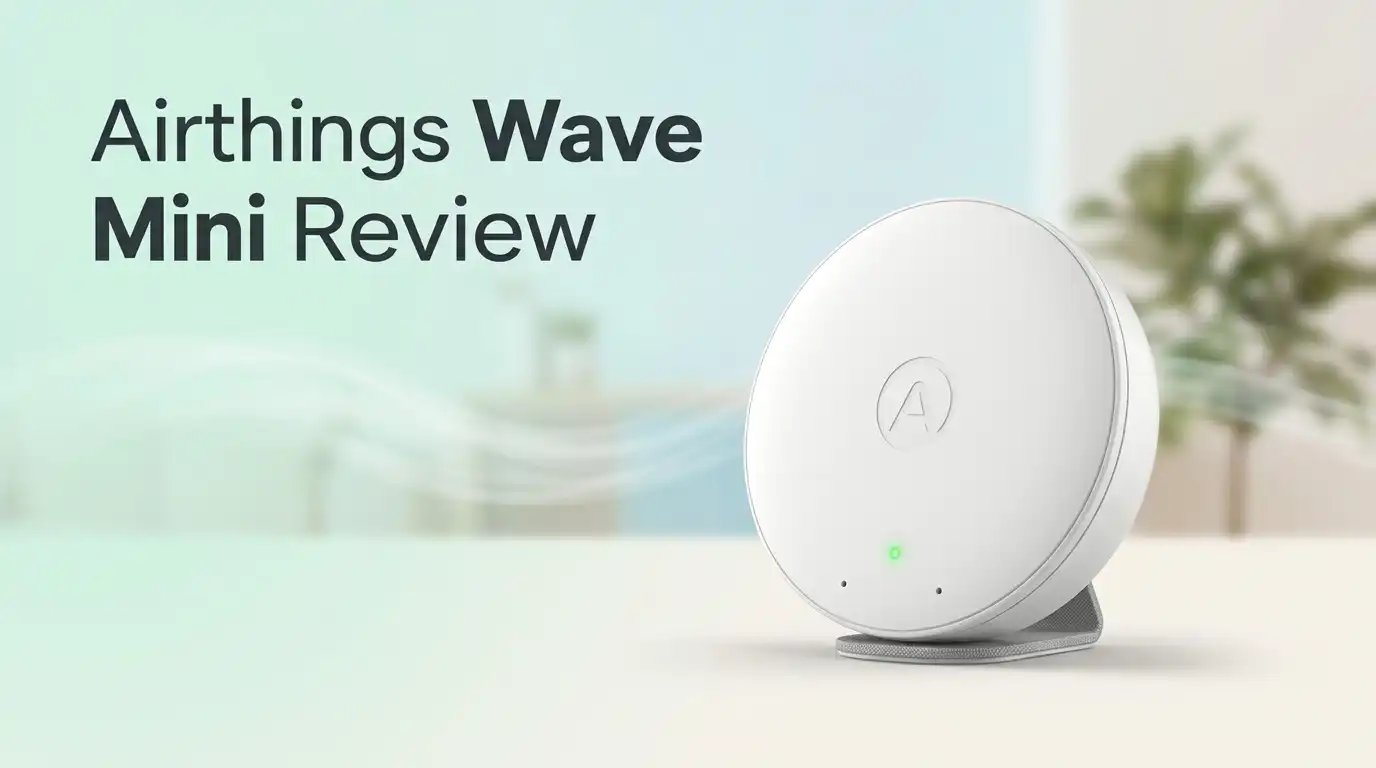
Airthings Wave Mini Review 2026: Still Worth It?
Indoor air affects how you sleep, think, and breathe every single day. Most people never see the problem because bad air has no color and often no smell. The Airthings Wave Mini promises to change that for a modest price.
This small sensor tracks airborne chemicals, temperature, and humidity. It also calculates mold risk, which almost no rival does. But a low price always brings compromises, and this device has a few real ones.
I spent weeks living with this monitor in a bathroom, a basement, and an office. Here is the honest picture, including the parts Airthings does not advertise.
Key Takeaways:
- It measures three things directly. The Wave Mini reads total volatile organic compounds (TVOC), temperature, and relative humidity. It does not read radon, carbon dioxide, or PM2.5 particles.
- Mold risk is calculated, not detected. The device uses a rolling 48 hour window of temperature and humidity data to estimate whether conditions favor mold growth. It never sees actual mold spores.
- There is no screen. A single LED glows green, yellow, or red when you wave your hand in front of it. Exact numbers live only inside the Airthings app.
- Bluetooth limits remote access. You must stand near the unit to sync data unless you buy the separate Airthings Hub, which adds real cost to a budget device.
- Battery life is excellent. Three AA batteries run the unit for more than two years in typical Bluetooth use, so maintenance is almost zero.
- Best use case is one specific room. Bathrooms, laundry rooms, basements, and garages suit it perfectly. As a whole home air quality monitor, it falls short.
Airthings Wave Mini Overview

Last update on 2026-11-18 / Affiliate links / Images from Amazon Product Advertising API
The Airthings Wave Mini is the entry point into the Airthings family. Airthings is a Norwegian company best known for radon detection, and that engineering background shows in the build.
The unit is a small white puck, roughly 3.1 inches wide and 1 inch deep. It weighs about 0.3 pounds with batteries installed. You can rest it on a shelf, stand it on the included table stand, or mount it on a wall.
Its job is narrow and clear. It watches the chemical load and moisture conditions in one room, then tells you when those conditions turn unhealthy. It sends no alarms, blocks no pollutants, and cleans nothing. Think of it as a quiet witness rather than a fixer.
Unboxing Experience
The box is small, plain, and recyclable, with a product photo on the front and sensor icons on the side. Nothing feels premium, and nothing feels cheap either.
Inside you get the Wave Mini itself, three AA alkaline batteries, a clip on table stand, and a short folded guide with regulatory paperwork. That is the entire contents list. There is no screwdriver, no adhesive pad, and no USB cable, because none are needed.
The whole unboxing takes about ninety seconds. You pop off the back cover, drop in the batteries, press the cover back, and the LED pulses to show life.
The pleasant surprise is the weight. The plastic shell feels dense in the hand, not hollow. The back cover snaps on with a clean click instead of a flex.
Design And Build Quality
The Wave Mini looks like a smoke detector that went to design school. The matte white finish hides dust reasonably well and blends into most ceilings and shelves.
Air inlets sit along the front face and around the sides, so airflow reaches the sensors from several directions. That placement matters, because a blocked inlet produces lazy readings.
A single LED sits behind the front panel. Wave your hand in front of the device and it lights up green for good, yellow for fair, or red for poor. The light stays off the rest of the time to save battery.
My biggest design complaint is the missing display. A tiny number on the face would have solved so much. Without it, a quick glance tells you almost nothing specific.
Top 3 Alternative For Airthings Wave Mini


Last update on 2026-11-18 / Affiliate links / Images from Amazon Product Advertising API
Airthings Wave Plus

Last update on 2026-11-18 / Affiliate links / Images from Amazon Product Advertising API
Airthings View Plus

Last update on 2026-11-17 / Affiliate links / Images from Amazon Product Advertising API
Amazon Smart Air Quality Monitor
Setup And The Airthings App
Setup is the easiest part of ownership. You download the Airthings app, create a free account, and let the app scan over Bluetooth. The Wave Mini appears within seconds.
You then name the device, choose the room type, and pick your units. The whole process takes under five minutes with no router passwords or QR codes involved.
The app itself is clean and genuinely useful. Graphs show hourly, daily, weekly, and monthly trends for each sensor, and that trend view is where the real value lives. A single reading means little. A pattern across two weeks means a lot.
One honest warning: the app requires an account, and the device will not show numbers without it. If you dislike app based hardware, this is not your monitor.
What The Airthings Wave Mini Measures
The Wave Mini carries three real sensors. The first reads total volatile organic compounds in parts per billion. These chemicals come from paint, cleaning sprays, candles, new furniture, air fresheners, and dry cleaned clothes.
Airthings uses simple thresholds for VOC levels. Below 250 ppb shows green, 250 to 2000 ppb shows yellow, and above 2000 ppb shows red.
The second sensor reads temperature with accuracy near 1 degree Celsius and a resolution of 0.1 degrees. The third reads relative humidity with accuracy near 3 percent and 1 percent resolution.
The unit samples every five minutes, which is frequent enough to catch a cooking spike or a long shower. Mold risk is the fourth value, but it is a calculation built from the other sensors rather than a separate sensor.
Mold Risk Indicator Explained
This feature is the headline act, and it deserves a careful explanation. The Wave Mini does not detect mold, mold spores, or mold smell.
Instead, the device tracks temperature and humidity across a rolling 48 hour period. Mold needs sustained warmth and moisture to grow, so the algorithm asks a simple question. Have conditions in this room stayed friendly to mold for long enough to matter?
That delay is intentional. A ten minute humidity spike from a hot shower does not grow mold. Three damp days in a basement corner absolutely can.
It will not catch a leak inside a wall, water under a floor, or spores already present behind drywall. Treat the reading as an early warning about conditions, not as a mold test. Used that way, it is genuinely clever.
Accuracy And Sensor Performance
Temperature and humidity readings tracked closely with my reference hygrometer, usually within a degree and a few percent. Those sensors are dependable.
The VOC sensor needs patience. It requires roughly seven days to build its baseline, so early readings should be treated with suspicion. Judging this device during week one is unfair to it.
The sensor also uses a relative baseline rather than an absolute scale. If the unit sits permanently in a chemical heavy room, it slowly learns to call that air normal.
Airthings recommends placing the monitor near an open window for about ten minutes now and then. That is not calibration, it is a reality check for the sensor. TVOC readings should be read as trend direction, never as laboratory numbers.
Battery Life And Daily Use
Three AA batteries power everything, and Airthings rates life at more than two years under normal Bluetooth use. My unit matched that pace comfortably.
Daily use is almost invisible. The device sits there, samples air, and asks nothing of you. You wave at it occasionally and open the app when something feels off.
The lack of wiring is a genuine advantage. You can place it inside a closet, on a laundry shelf, or in a crawl space with no outlet nearby.
One recurring complaint from owners deserves mention. Some users report battery corrosion over long periods, especially in humid rooms, which is ironic given the mold risk focus. Lithium AA batteries and an annual check solve most of this.
Airthings Hub And Smart Home Support
Out of the box, the Wave Mini speaks only Bluetooth. That means your phone must come within range before data syncs to the cloud.
The optional Airthings Hub fixes this by connecting the monitor through Airthings SmartLink to the internet. Readings then update remotely, and you can check your basement from a hotel room.
The Hub also opens the door to Amazon Alexa, Google Assistant, and IFTTT integrations. It improves connectivity only, and does nothing for sensor accuracy.
Here is the sting. A budget monitor that needs a separate Hub for remote access is no longer a budget purchase. If remote monitoring matters to you, price the Hub into your decision before you buy, or consider a monitor with built in Wi Fi instead.
Pros And Cons Of The Airthings Wave Mini
Last update on 2026-11-18 / Affiliate links / Images from Amazon Product Advertising API
Pros
- Mold risk indication is rare and useful, especially for basements, bathrooms, and laundry rooms where moisture builds slowly.
- Setup takes under five minutes with no router configuration or hub required for basic use.
- Battery life exceeds two years on three AA cells, so the device needs almost no attention.
- The Airthings app shows clear long term graphs, which makes patterns easy to spot.
- Build quality feels solid, and the wall mount option plus table stand give real placement freedom.
- The price sits well below most multi sensor air quality monitors.
Cons
- No numerical display at all. The LED gives only a color, so the app becomes mandatory for detail.
- It ignores PM2.5, carbon dioxide, and radon, which are three of the biggest indoor air concerns.
- Bluetooth only connectivity blocks remote checks unless you buy the Hub separately.
- The VOC sensor uses a relative baseline and needs a week to settle.
- Reports of battery corrosion appear in long term owner feedback.
What The Airthings Wave Mini Does Not Do Well
Honest reviews name the weak spots plainly, so here they are. This monitor is not a complete air quality picture. Skipping PM2.5 is the biggest gap, because fine particles from cooking, wildfire smoke, and traffic carry serious health weight.
Carbon dioxide is the second gap. Stuffy bedrooms and crowded offices suffer from rising CO2, and the Wave Mini cannot see it at all.
The display problem compounds everything. You cannot walk past the unit and learn anything precise. You learn one of three colors, and only if you remember to wave.
TVOC accuracy is also directional rather than absolute. The number tells you whether chemicals are rising or falling, not exactly how many parts per billion float around you.
Finally, it fixes nothing. This is a measuring tool, so a ventilation plan or air purifier still has to follow.
Who Should Buy The Airthings Wave Mini
This device suits a specific buyer very well. If you have one problem room, this is a smart and cheap way to understand it.
Basement owners, renters with damp bathrooms, people with poorly ventilated laundry rooms, and anyone who has already fought mold once will get real value here. The 48 hour mold risk logic answers exactly their question.
It also fits people who already own an Airthings radon monitor and want to extend coverage into another room through the same app.
Skip it if you want one device to watch everything. Allergy sufferers who care about dust and smoke need PM2.5. Students and remote workers tracking drowsiness need CO2. Both groups should spend more and buy a fuller monitor instead of saving money here.
Price And Value In 2026
The Wave Mini carries a list price near 79 dollars, and street prices often slide into the 60s during sales. That positions it as one of the cheapest smart air monitors from a respected brand.
Value depends entirely on expectations. As a dedicated mold risk and VOC sensor for one room, the price feels fair. As a general air quality monitor, the same money starts to feel thin, because rivals near 100 dollars include particle sensors and screens.
Add the Hub and the total climbs close to mid range monitors with built in Wi Fi and displays. That math is where many buyers change their minds.
Warranty helps the case. Airthings offers one year as standard in many markets, extendable up to five years when you register the device within 30 days.
Final Verdict
The Airthings Wave Mini is a focused tool that does its narrow job well and refuses to pretend otherwise. Build quality, battery life, and app graphs all land above expectations for the price.
The mold risk indicator remains its standout trick, and nothing else at this price explains moisture conditions so clearly. That alone justifies a purchase for the right room.
The limits are equally clear. No display, no particle sensor, no CO2 sensor, and no remote access without extra spending.
My recommendation is simple. Buy it as a second monitor or as a targeted mold watchdog, and you will be satisfied. Buy it hoping for a complete indoor air dashboard, and you will feel shortchanged within a month.
Frequently Asked Questions
Does the Airthings Wave Mini detect mold?
No. It estimates mold risk using temperature and humidity data across a rolling 48 hour period. It cannot see spores or find hidden moisture inside walls.
Do I need the Airthings Hub?
Only for remote access. Bluetooth works fine when your phone is nearby, but the Hub is required to check readings while you are away from home.
How long do the batteries last?
Airthings rates the three AA batteries at more than two years with Bluetooth use. Lithium cells help avoid corrosion in humid rooms.
Does it measure PM2.5 or carbon dioxide?
No. The Wave Mini reads only TVOC, temperature, and humidity. Choose the Wave Plus or View Plus if you need radon, CO2, or particle readings.
Where should I place the Wave Mini?
Place it in the room you worry about most, roughly at breathing height, away from vents, windows, and direct sunlight. Keep the air inlets clear.
Is the Airthings app free?
Yes. The app and basic cloud features require no subscription, though an account is required to view numerical readings.

I’m Maya Brown, the voice behind Pure Breeze Vault. I write detailed, honest, and easy-to-follow air purifier reviews to help readers compare features, understand filter technologies, and choose products with confidence. My goal is to make research simpler, clearer, and more practical for anyone improving indoor air quality at home.