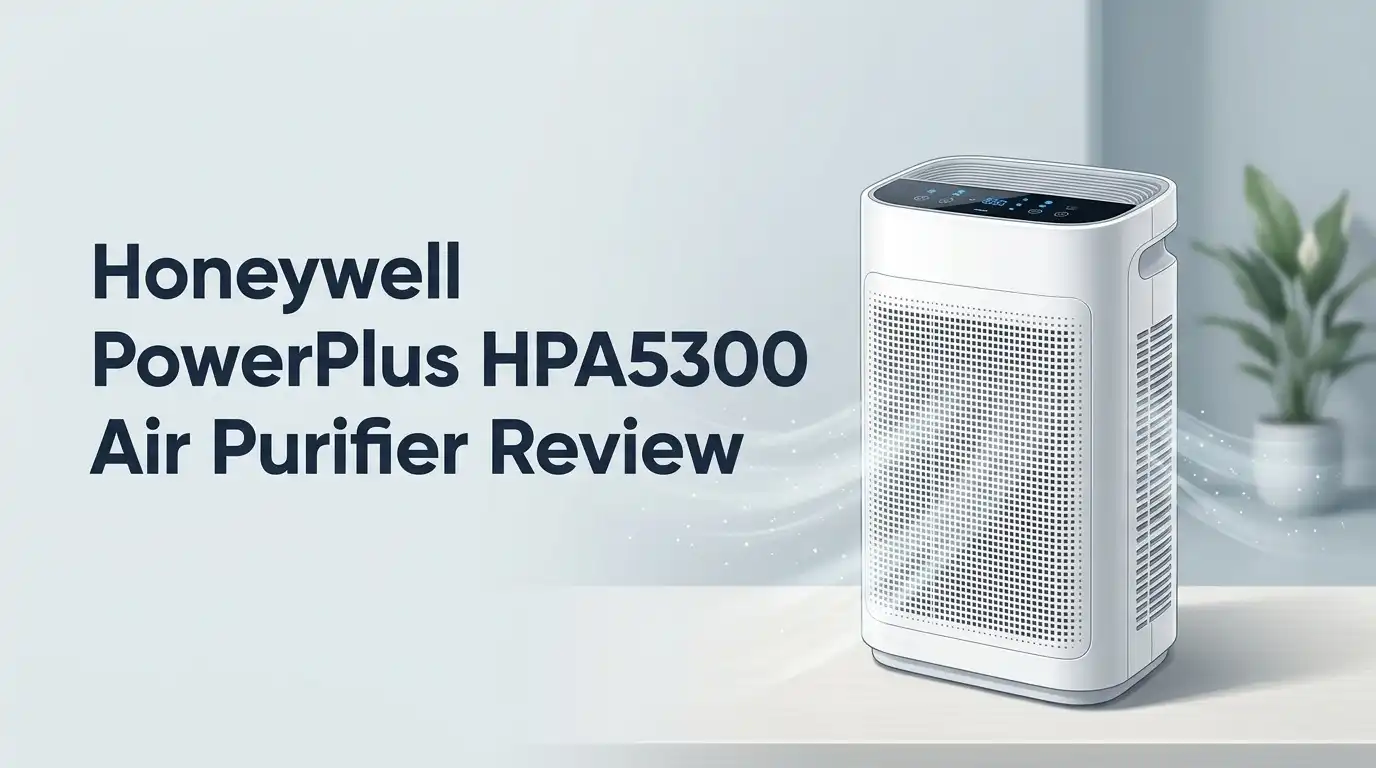
Honeywell PowerPlus HPA5300 Air Purifier Review 2026: Worth Buying?
Clean air at home should not feel like a luxury. Yet most people only think about air quality after a smoky week, a dusty renovation, or a sneezing fit that will not quit.
The Honeywell PowerPlus HPA5300 promises to fix that problem in big rooms, and it does so without touching your phone or asking for a subscription. This review covers the unboxing, the real performance numbers, the running costs, and the honest weak spots that marketing pages skip.
By the end, you will know if this large room purifier belongs in your living room, or if your money is better spent somewhere else in 2026.
In a Nutshell:
- Strong raw power for the price. The HPA5300 delivers a CADR of around 339 for dust, 335 for pollen, and 323 for smoke. That is enough airflow to clean a 500 square foot room roughly five times per hour, which is the rate allergy sufferers actually need.
- True HEPA filtration without gimmicks. The unit captures up to 99.97% of particles down to 0.3 microns, including pet dander, pollen, mold spores, and wildfire smoke particles. There is no ozone generator and no UV marketing fluff.
- The InSight sensor is the headline upgrade. A gas sensor sits near the air inlet, reads the room, and bumps the fan speed up automatically. Color coded lights on the front panel show air quality at a glance.
- It is loud at full speed. Expect around 30 decibels on the lowest setting and close to 62 decibels on turbo, which is louder than most modern competitors.
- No WiFi, no app, no voice control. In 2026 that feels dated, especially when cheaper rivals include smart features as standard.
- Filters cost real money. Budget roughly $90 to $130 per year for HEPA filters and prefilters combined.
What Is the Honeywell PowerPlus HPA5300?


Last update on 2026-11-18 / Affiliate links / Images from Amazon Product Advertising API
The HPA5300 is Honeywell’s extra large room air purifier, sold under the InSight and PowerPlus naming in different markets.
It is a floor standing tower in matte black that treats rooms up to 500 square feet. Inside, three HEPA filter panels sit behind a carbon prefilter, and a single large fan pulls air in from the bottom and pushes it out of the top grille.
Honeywell built this model on the same mechanical platform as the older HPA300, a unit that earned a loyal following for sheer airflow.
The HPA5300 adds the InSight smart sensor, an Energy Star rating, and a cleaner display panel. Think of it as the HPA300 with a brain added, not a total redesign.
Unboxing Experience and First Setup
The box is heavy. At 27 pounds packed, you will want two hands or a friend for the stairs. Honeywell wraps the unit in molded foam with a cardboard sleeve, and there is no plastic shrink wrap on the body itself. Inside you get the purifier, a short manual, and the three HEPA filters already seated in their slots.
Setup takes under five minutes. You pop the front cover off, pull the plastic bags from each filter, slide the carbon prefilter into the front frame, and click the cover back on.
The prefilter is the only annoying part. It bends easily and needs a firm push into its channel. First power on is instant, with the sensor running a short calibration before auto mode responds properly.
Design, Size, and Build Quality
The HPA5300 measures roughly 22.3 inches tall, 19 inches wide, and 10 inches deep. It is slim from front to back, so it tucks against a wall without eating floor space, but the wide stance means it is not a nightstand unit. The vertical grille lines look sharp and collect less dust than older horizontal slat designs.
The plastic feels thick and the panels do not flex when you lift the unit. There are no wheels and no recessed handle, which is a real miss on something this heavy.
Controls sit on a clear top panel that Honeywell calls Display At a Glance. The buttons are touch sensitive, responsive, and bright enough to read across a dark room.
Top 3 Alternative for Honeywell PowerPlus HPA5300

Last update on 2026-11-17 / Affiliate links / Images from Amazon Product Advertising API
Levoit Core 600S

Last update on 2026-11-17 / Affiliate links / Images from Amazon Product Advertising API
Coway Airmega AP-1512HH Mighty

Last update on 2026-11-17 / Affiliate links / Images from Amazon Product Advertising API
Winix 5510
Filtration System Explained
The HPA5300 uses a two stage system with an optional third layer. The first stage is a carbon prefilter that traps hair, lint, and large dust while absorbing some odors.
Honeywell recommends swapping it every three months. The second stage is the True HEPA filter set, three panels of pleated media rated to capture 99.97% of particles down to 0.3 microns.
Honeywell also sells formulated carbon inserts for specific problems: one blend targets smoke, another targets pet odors, another targets kitchen smells, and another targets general household VOCs.
This modular approach is clever, but it also means the best odor control costs extra. Out of the box, odor removal is decent but not outstanding, because the carbon layer is thin compared with dedicated carbon units.
Room Coverage and CADR Numbers
Honeywell rates the HPA5300 for 500 square feet with roughly five air changes per hour. That translates to a full room turnover about every 12 minutes, which matters far more than the headline square footage number plastered on the box.
Many brands quote coverage at one air change per hour, which looks impressive and helps nobody with allergies.
The AHAM verified CADR figures are 339 CFM for dust, 335 CFM for pollen, and 323 CFM for smoke. Those numbers put the HPA5300 in the top tier for its price bracket.
In practical terms, it comfortably handles an open plan living and dining space, a large master bedroom, or a finished basement. Push it past 600 square feet and performance drops noticeably.
Real World Performance
In a 300 square foot room with a dusty carpet and two cats, the HPA5300 cleared visible haze and settled pet dander within an hour on medium speed.
Cooking smells disappeared faster than expected, though a heavy fried fish dinner took about 40 minutes to clear fully on turbo.
The sensor reacts quickly. Lighting a candle or spraying deodorant flips the indicator from blue to red within 15 seconds, and the fan ramps up on its own.
Allergy users report the biggest difference overnight, with less morning congestion after a week of continuous running. Dust accumulation on nearby furniture drops within days. This is a brute force machine, and brute force works.
Noise Levels and Sleep Use
Noise is the clearest trade off here. On the lowest setting, the HPA5300 produces around 30 decibels, a soft whoosh that fades into the background. Speed two is still bedroom friendly. Speed three starts to intrude on quiet conversation and television.
Turbo mode hits roughly 62 decibels, which sounds like a loud bathroom fan. You will not sleep through it, and you will reach for the remote during a movie. The fan tone is low pitched rather than whiny, which makes it less irritating than some rivals at the same volume.
A dirty filter makes the unit noticeably louder, so noise creep is often a sign you need to vacuum the prefilter rather than a sign of failure.
Energy Use and Running Costs
The HPA5300 carries an Energy Star rating and draws about 108 watts at maximum speed. On lower settings, consumption falls well below that figure. Running the unit eight hours a day on a mid speed setting costs roughly $35 to $40 per year at average United States electricity rates.
That is reasonable for a machine with this much airflow, and it improves on the older HPA300, which burned more power for slightly less output.
Auto mode is the real money saver, since the purifier idles at low speed in clean air and only spins up when the sensor detects a problem. If you run the unit on turbo around the clock, expect your yearly cost to roughly triple.
Filter Replacement Costs and Maintenance
Maintenance is simple but not cheap. The HEPA filters are rated for 12 months and the carbon prefilter for three months.
A three pack of genuine R filters typically runs $90 to $130, while a four pack of prefilters costs around $20 to $30. Annual upkeep lands near $110 for most households.
Third party filters exist at half the price, and many perform acceptably, though fit can be loose and Honeywell may question warranty claims. A filter change indicator on the display tells you when each layer needs attention.
Vacuuming the prefilter monthly extends its life considerably. The filters themselves slide in and out easily once the front cover is removed, with clear labels showing orientation.
Smart Sensor, Modes, and Extra Features
The InSight sensor is the main reason to pick the HPA5300 over the older HPA300. It is a gas type sensor, which reacts to cooking fumes, smoke, and aerosols faster than cheap particle only sensors. Auto mode uses that reading to pick the right fan speed with no input from you.
You also get four fan speeds, a timer with 2, 4, and 8 hour options, a dimmer for the display, and a filter replacement reminder.
There is no app, no WiFi, and no voice assistant support. Honeywell reserves smart connectivity for other models. For some buyers that simplicity is a feature, since there is nothing to pair, update, or troubleshoot.
What the HPA5300 Does Not Do Well
Honest reviews name the flaws, so here they are. The prefilter is genuinely fiddly to install and messy to remove for cleaning. Competitors solved this problem years ago with magnetic or clip on front panels.
Odor removal is average without the optional carbon inserts, so heavy smokers and households with strong kitchen smells will want to budget extra. The unit is loud at high speed and far too loud for light sleepers.
There are no wheels, so moving it between rooms is a chore. The lack of WiFi feels outdated in 2026. Honeywell customer service also lags behind rivals, with restocking fees on returns and no free shipping on direct orders.
Pros and Cons
Pros
- Excellent airflow for the price, with AHAM verified CADR figures that beat many pricier models.
- True HEPA filtration that captures 99.97% of particles down to 0.3 microns, with no ozone output.
- Responsive InSight gas sensor and a genuinely useful auto mode.
- Energy Star certified, with modest running costs of roughly $39 per year on typical use.
- Up to five years of warranty coverage, among the longest in the category.
- Simple controls that anyone in the household can operate without a manual.
Cons
- Reaches about 62 decibels on turbo, which is too loud for sleep or quiet work.
- No WiFi, app control, or voice assistant support.
- Prefilter installation and removal is awkward and messy.
- Heavy at 27 pounds with no wheels or proper handle.
- Annual filter costs of roughly $110 add up over the life of the unit.
- Carbon layer is thin, so strong odors need the optional formulated inserts.
Honeywell HPA5300 vs HPA300: What Changed?
The HPA300 remains a cult favorite and still sells well. Both units share the same filter format, the same three panel HEPA layout, and similar physical dimensions. The differences come down to intelligence and efficiency.
The HPA5300 adds the InSight sensor and true auto mode, which the HPA300 lacks entirely. It also carries an Energy Star rating and uses less power per unit of airflow.
CADR is slightly higher on the HPA5300 across dust, smoke, and pollen. The HPA300 is cheaper and mechanically simpler, which some buyers prefer. If you want set and forget operation, pay the difference. If you plan to leave it running on one speed anyway, save the money.
Who Should Buy the Honeywell PowerPlus HPA5300?
Last update on 2026-11-18 / Affiliate links / Images from Amazon Product Advertising API
This purifier suits households with allergies, pets, or seasonal smoke exposure who need to treat a genuinely large room.
It is a strong fit for open plan living areas, family rooms, and large bedrooms where airflow matters more than silence. Renters and homeowners who dislike apps will appreciate the straightforward button layout.
Skip it if you need whisper quiet overnight operation at high speed, if smart home integration is a priority, or if your room is under 250 square feet.
Smaller rooms do not need this much fan, and you would be paying for airflow you never use. Buyers chasing the lowest possible filter costs should also look elsewhere.
Final Verdict
The Honeywell PowerPlus HPA5300 is a powerful, dependable large room air purifier that earns its place through raw performance rather than clever features.
Filtration is excellent, coverage claims are honest, energy use is reasonable, and the warranty is generous. The InSight sensor works well and makes daily use effortless.
The flaws are real but predictable. It is loud at full tilt, it skips WiFi entirely, the prefilter fights you, and filters are not cheap. Rated honestly, this is a solid 4.3 out of 5 machine.
If quiet smart features top your list, look at the Levoit Core 600S. If clean air in a big room is the only goal, the HPA5300 delivers every time.
Frequently Asked Questions
How often should I change the HPA5300 filters?
Replace the True HEPA filters every 12 months and the carbon prefilter every three months. The filter check indicator on the display reminds you. Vacuuming the prefilter monthly extends its usable life.
Does the Honeywell HPA5300 produce ozone?
No. The unit uses purely mechanical filtration with HEPA media and carbon. There is no ionizer and no ozone generation, which makes it safe for asthma sufferers and small children.
Can the HPA5300 handle wildfire smoke?
Yes, for particles. The HEPA filter captures fine smoke particulate effectively. For the smoke smell, add the optional formulated carbon insert, since the standard prefilter handles odor only moderately.
Is the HPA5300 quiet enough for a bedroom?
On speeds one and two, yes. On turbo it reaches around 62 decibels, which most people find too loud for sleeping. Run it on turbo before bed, then drop to low.
Does the HPA5300 work with WiFi or an app?
No. This model has no wireless connectivity, no companion app, and no voice assistant support. All control happens through the touch panel on top of the unit.
What size room is best for this purifier?
Honeywell rates it for 500 square feet at five air changes per hour. It performs best between 300 and 500 square feet. Larger spaces reduce the cleaning rate noticeably.

I’m Maya Brown, the voice behind Pure Breeze Vault. I write detailed, honest, and easy-to-follow air purifier reviews to help readers compare features, understand filter technologies, and choose products with confidence. My goal is to make research simpler, clearer, and more practical for anyone improving indoor air quality at home.