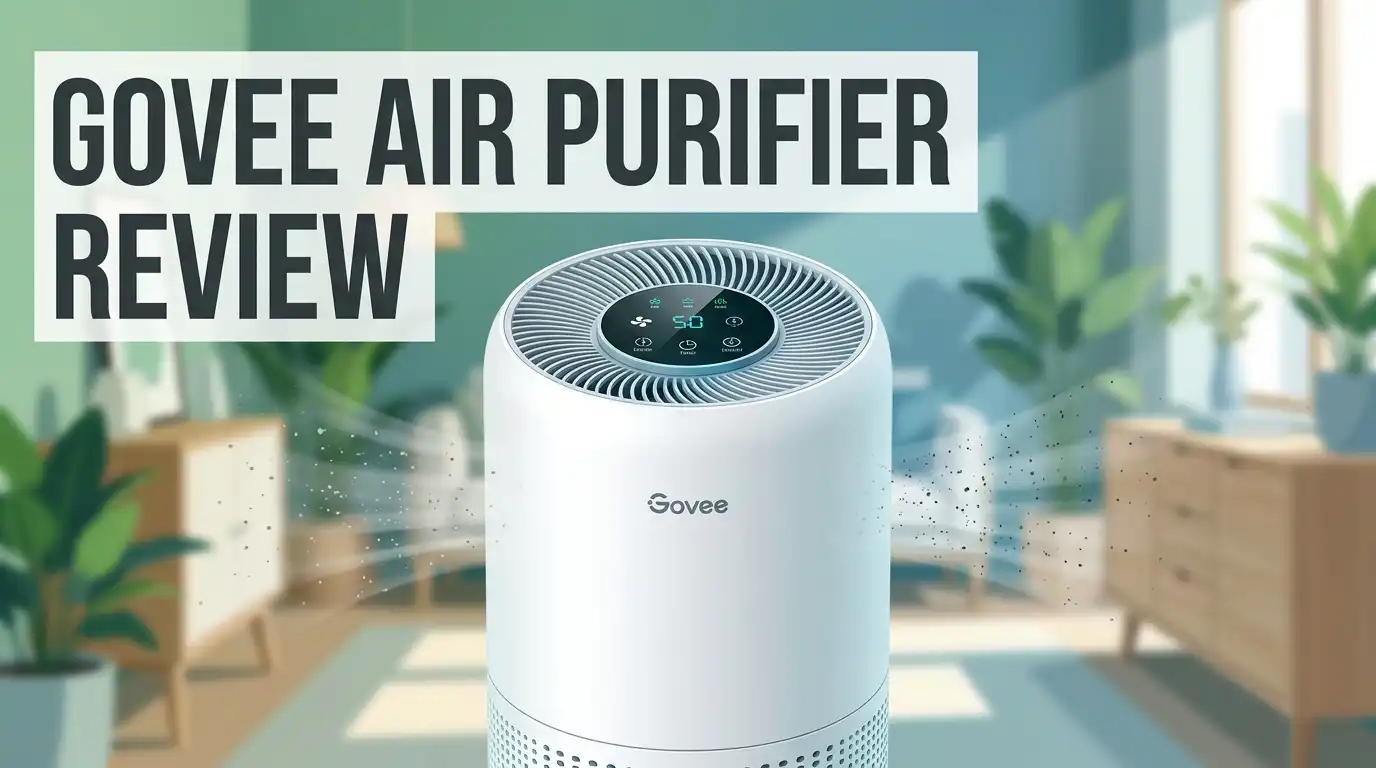
Govee Air Purifier Review 2026: Worth Buying?
Clean air matters more than ever in 2026. Wildfire smoke drifts further each summer. Pollen seasons stretch longer. Pets shed year round. So people shop for air purifiers that look good, cost little, and connect to a phone.
Govee built its name on smart lighting. Now the brand sells air purifiers under the GoveeLife label. These units promise app control, HEPA filtration, and prices that undercut big names like Coway and Levoit.
But do they clean air well, or do they just look clever on a shelf? I spent time with the GoveeLife lineup, read hundreds of owner reports, and compared lab style test data from independent testers.
In a Nutshell:
- Govee air purifiers offer strong value for the money. The Smart Air Purifier 2 Pro sells for under $100 and delivers 150 CFM of clean air delivery rate on turbo mode. That number sits close to units costing twice as much.
- The app experience is the real selling point. Govee Home handles scheduling, fan speed, filter life tracking, and voice commands through Alexa and Google Assistant. If you already own Govee lights, everything lives in one place.
- Coverage claims need a reality check. Govee advertises up to 1162 square feet, but that figure counts air volume rather than floor space. Plan for roughly 230 to 500 square feet for real results.
- Auto mode requires a separate purchase. The purifier does not include a built in PM2.5 sensor on most models. You must buy the GoveeLife Air Quality Monitor to unlock automatic fan adjustment.
- Odor removal is the weakest area. The carbon layer uses coated fiber instead of carbon pellets. Cooking smells and cigarette smoke linger longer than they should.
- Filters are proprietary and oddly sized. You cannot swap in a generic replacement from a hardware store, so you stay tied to Govee pricing.
GoveeLife Smart Air Purifier 2 Pro

Last update on 2026-11-17 / Affiliate links / Images from Amazon Product Advertising API
The Smart Air Purifier 2 Pro is the flagship. Govee lists it as model H7129, and it carries an iF Design Award for its cylinder shape and soft LED ring.
Specs are respectable. You get an H13 grade HEPA filter, a 32W motor, a CADR of 150 CFM on turbo, and a quoted 24dB sleep mode. Dimensions measure 8.66 inches wide by 15.55 inches tall, so it fits beside a nightstand without crowding the lamp.
The LED ambient light is the fun part. It shifts colors through the app and doubles as a night light. Some owners love it. Others turn it off within a week.
Build quality feels better than the price suggests. The plastic does not flex. The top grille sits flush. Nothing rattles at full speed. For under $100, that is a pleasant surprise.
The Unboxing Experience
Govee packs this unit well. The box arrives slim and light, around 10 pounds with padding. Inside you find molded pulp trays rather than foam, which recycles easily.
The purifier sits upright in the center. Beneath it you get a power adapter, a quick start card, a full manual, and a small sleeve of aroma pads.
One step trips up new owners. The filter ships inside the unit still wrapped in plastic. You must twist off the base, pull the filter out, strip the wrap, and reseat it. Skip that step and airflow drops to almost nothing. The quick start card mentions it, though the text is small.
Setup after that takes about four minutes. Plug in, open Govee Home, tap add device, and the purifier pairs over Bluetooth before switching to your 2.4GHz network. No fiddly access point mode.
GoveeLife Smart Air Purifier for Large Rooms

Last update on 2026-11-17 / Affiliate links / Images from Amazon Product Advertising API
This model sits one step below the Pro. Govee rates it at 135 CFM and markets it for areas up to 1046 square feet.
The key difference is the sensor. This version includes a built in PM2.5 monitor, so auto mode works without buying extra hardware. The display shows a live particle reading, which makes the machine feel useful rather than mysterious.
It uses the same style of 3 in 1 filter: a mesh pre filter, a true HEPA layer, and an activated carbon layer. A 24dB sleep mode keeps it quiet overnight.
I prefer this unit over the Pro for most buyers. You lose 15 CFM, but you gain the sensor that makes smart features actually smart. Paying less for more function is an easy call.
Top 3 Alternative for GoveeLife Smart Air Purifier


Last update on 2026-11-19 / Affiliate links / Images from Amazon Product Advertising API
Levoit Core 300 P Air Purifier

Last update on 2026-11-17 / Affiliate links / Images from Amazon Product Advertising API
Coway Airmega AP 1512HH Mighty Air Purifier

Last update on 2026-11-17 / Affiliate links / Images from Amazon Product Advertising API
Winix 5510 Air Purifier
Filtration System Explained
Govee uses three layers in one cylinder. Understanding each layer tells you what the machine can and cannot do.
The pre filter is a nylon mesh. It catches hair, lint, and fiber. You can vacuum it or rinse it, which extends the life of everything behind it. Clean it monthly.
The HEPA layer does the heavy work. Govee rates it at 99.97 percent efficiency for particles between 0.1 and 0.3 microns. That handles pollen, dust, mold spores, and fine smoke particles.
The carbon layer is the weak link. It is a fibrous sheet coated with carbon dust rather than a tray of carbon pellets. Coated fiber grabs some gases, but it saturates fast.
No ionizer. No UV lamp. That means zero ozone output, which is genuinely good news for anyone with asthma.
Real World Performance Test Results
Independent testing paints a mixed picture. In controlled room tests, the small GoveeLife Mini cut particle counts by 87 percent in a 120 square foot room over 60 minutes. In a 194 square foot room, that figure fell to 77 percent.
That pattern tells the story. Govee units perform honestly inside their true range and struggle past it.
The larger Pro and 1046 model do better because they push far more air. Owners running the Pro in a 250 square foot bedroom report PM2.5 readings dropping from unhealthy to single digits within 30 minutes on turbo.
Push either unit into an open plan living area and results slow dramatically. The air still gets cleaner, just over hours instead of minutes. Match the machine to one closed room and you will be happy.
Noise Levels and Sleep Mode
Noise is where Govee quietly wins. The motor tuning is good across the lineup.
Sleep mode on the Pro measures around 24dB by the manufacturer rating, and independent meters put the smaller models near 40dBA at their lowest setting. Either way, the sound is a soft whoosh rather than a whine.
Turbo mode is a different animal. Expect somewhere between 55 and 57dBA, roughly the level of a running dishwasher. You will hear it from across the room. You will not hold a phone call beside it.
Sleep mode also dims the LEDs. That matters more than people expect. A glowing air purifier ruins a dark bedroom, and Govee handles the blackout properly through both the panel and the app.
The Govee Home App Experience
The app is the reason to pick Govee over a cheaper no name unit. It works, and it works consistently.
You get fan speed control, a timer, advanced scheduling by day and hour, filter life percentage, display brightness toggles, and voice assistant linking. Scenes let you tie the purifier to other Govee devices, so a bedtime routine can dim your lights and drop the fan together.
Pairing is fast and reconnection after a power cut is reliable, which is more than I can say for several competitors.
The downsides are small but real. The app pushes promotional notifications. The interface buries some settings two taps deeper than needed. And Govee devices live inside Govee Home rather than connecting natively to HomeKit or Matter, which frustrates users with mixed smart home setups.
Auto Mode and the Sensor Catch
This is the single most important thing to understand before you buy.
The Smart Air Purifier 2 Pro has no built in air quality sensor. Auto mode exists, but it only activates when you pair the purifier with the GoveeLife Air Quality Monitor, model H5106, sold separately for around $30 to $40.
Govee discloses this in the fine print. Plenty of buyers still miss it and feel cheated when they unbox the unit.
There is an upside to the split design. A standalone sensor can sit across the room, away from the purifier’s own clean air stream, which gives a more honest reading of the space.
Still, if you want auto mode out of the box, choose the 1046 square foot model with the integrated PM2.5 monitor instead. Same brand, lower price, fewer surprises.
Coverage Claims: Read the Fine Print
Govee advertises 1162 square feet for the Pro. That number deserves scrutiny.
The figure describes total air volume treated, not floor area at a useful air change rate. Govee’s own support team has stated the recommended space is roughly 35 square meters, which equals about 377 square feet. The in app coverage display sometimes shows a different number than the listing.
Here is the practical math. At 150 CFM, you get five air changes per hour in a room near 230 square feet with standard ceilings. Drop to two changes per hour and you can stretch to roughly 580 square feet.
Five changes per hour is the standard for allergy and smoke relief. Two changes is maintenance level. Shop by CFM, never by the square footage printed on the box.
Filter Costs and Maintenance
Replacement filters run roughly $20 to $30 per unit depending on model and pack size. Govee quotes a life of six to eight months.
Real life tends to be shorter. Homes with pets, smokers, or heavy cooking often see airflow drop by month four or five. The filter indicator helps, but your nose is the better judge.
The proprietary sizing is the genuine complaint. Govee filters are not a standard dimension, so third party options are limited and you cannot cut a generic HEPA sheet to fit. You buy from Govee or from a small handful of compatible sellers.
Cleaning the pre filter every few weeks makes a measurable difference. Peel it away from the HEPA core, vacuum it, rinse it if greasy, dry it fully, then reinstall. Never wash the HEPA or carbon layers.
Power Consumption and Running Costs
Energy use is excellent. The Pro draws 32W at maximum speed. The Mini draws just 8W.
Run the Pro on turbo 24 hours a day at 12 cents per kWh and you add roughly $2.75 per month to your bill. Run it on sleep mode and the cost falls to pennies.
The Mini is even cheaper. Independent measurement put it at $0.65 per month at full speed, which is close to free.
Most Govee purifiers carry Energy Star certification, plus ETL and FCC listing. Those marks confirm the unit was tested for safety and efficiency rather than just assembled and shipped.
Add filters and electricity together and annual ownership lands near $45 to $70. That is competitive, though Levoit and Coway filters often last longer per dollar.
Design and Placement Tips
The cylinder shape draws air in through the base and exhausts straight up. That design works well in open positions and poorly in tight ones.
Keep at least 8 inches of clearance on all sides. Push a Govee purifier into a corner or against a curtain and performance collapses while the motor strains.
The best spots are beside a bed, next to a sofa, or near a doorway where air naturally moves. Avoid placing it behind furniture.
Aesthetically, these units look sharp. White and black finishes, clean lines, no visible branding on the front. The optional ambient light turns the purifier into soft decor.
One complaint: there are no carry handles or grip slots. The larger models weigh enough that moving them between rooms means hugging a smooth plastic cylinder.
What Govee Air Purifiers Do Not Do Well
Honest reviews name the flaws. Here are mine.
Odor control disappoints. Fried fish, litter boxes, and cigarette smoke all persist. The coated fiber carbon layer simply lacks the mass to adsorb gases properly. If smells are your main problem, buy a unit with a pellet carbon tray.
No AHAM Verifide certification. Levoit and Coway submit models to independent CADR verification. Govee publishes its own numbers. They may well be accurate, but you are trusting the manufacturer.
Formaldehyde and VOC claims are thin. Do not expect meaningful chemical removal.
Customer service is inconsistent. Warranty coverage runs 12 months, and owner reports on replacement part availability vary widely.
And marketing language stretches further than it should. The coverage figures are technically defensible and practically misleading.
Pros and Cons
Pros
- Excellent price to performance ratio, with the Pro delivering 150 CFM for under $100
- Genuinely good app, offering scheduling, filter tracking, and reliable reconnection
- Very low power draw, with Energy Star certification on key models
- Quiet sleep mode with full LED dimming for bedrooms
- H13 grade HEPA media rated at 99.97 percent efficiency
- No ozone output, since there is no ionizer or UV lamp
- Washable pre filter that extends overall filter life
- Award winning design with optional ambient lighting
- Affordable replacement filters compared to premium brands
Cons
- No built in sensor on the Pro, so auto mode needs a separate monitor purchase
- Coverage claims count air volume rather than usable floor area
- Weak odor and smoke neutralization from the coated fiber carbon layer
- Proprietary filter sizing with few third party alternatives
- No AHAM Verifide third party CADR confirmation
- Turbo mode is clearly audible at roughly 56dBA
- No native HomeKit or Matter support
- No carry handles on the larger units
- Only a 12 month warranty
Who Should Buy a Govee Air Purifier
Buy one if you want smart control on a tight budget and your target room is a bedroom, nursery, home office, or den under 300 square feet.
Buy one if you already own Govee lights. The shared app and scene system genuinely add convenience.
Buy one if dust, pollen, and pet dander are your concerns. Particle filtration is where these units perform.
Skip them if odors drive your purchase. Kitchen smells, cigarette smoke, and chemical fumes need pellet carbon.
Skip them if you need one machine for a large open living area. Buy a higher CFM unit instead, or run two smaller purifiers.
Skip them if third party certification matters to you. Coway and Levoit publish AHAM verified numbers, and that documentation has value.
Final Verdict
Govee air purifiers are good products wrapped in overconfident marketing.
Strip away the coverage claims and you find solid machines. The HEPA filtration works. The motors are quiet and efficient. The app is one of the better ones in this price bracket. Build quality beats expectations.
My pick is the GoveeLife Smart Air Purifier with the 1046 square foot rating, because the integrated PM2.5 sensor makes auto mode work without extra spending.
Rate the lineup around 7.5 out of 10. Govee has not beaten Coway or Winix on pure cleaning performance, and it has not matched Levoit on certification transparency. But it undercuts all of them on price while offering smarter software.
For one bedroom, one budget, and realistic expectations, that is a fair trade.
Frequently Asked Questions
Do Govee air purifiers produce ozone?
No. Govee purifiers use mechanical filtration only. There is no ionizer, no UV lamp, and no plasma generator, so no ozone is created as a byproduct. That makes them safe for people with asthma and for homes with pets or young children.
How often should I replace the Govee filter?
Govee recommends every six to eight months. In practice, plan for four to six months in homes with pets, smokers, or frequent cooking. Clean the washable pre filter monthly to stretch the HEPA layer’s life. The app tracks remaining filter percentage and the panel shows a reset indicator.
Does the Govee Smart Air Purifier 2 Pro have a built in air quality sensor?
No. The Pro requires the separate GoveeLife Air Quality Monitor H5106 to activate auto mode. If you want a sensor included, choose the 1046 square foot model, which has an integrated PM2.5 monitor and a live display reading.
What room size does a Govee air purifier actually cover?
At 150 CFM, expect strong results in rooms near 230 square feet with five air changes per hour. You can stretch to roughly 580 square feet at a lower two changes per hour. Ignore the 1162 square foot headline figure, which measures air volume rather than floor area.
Can I use Govee purifiers with Apple HomeKit?
Not natively. Govee devices work through the Govee Home app and support Alexa and Google Assistant voice control. HomeKit and Matter integration are not available on the purifier line, though some community bridges exist for advanced users.
Are Govee air purifiers loud?
Sleep mode is very quiet, rated at 24dB on the Pro. Turbo mode reaches roughly 56dBA, similar to a dishwasher. Most owners run the middle speed overnight and reserve turbo for cooking cleanup or smoky days.

I’m Maya Brown, the voice behind Pure Breeze Vault. I write detailed, honest, and easy-to-follow air purifier reviews to help readers compare features, understand filter technologies, and choose products with confidence. My goal is to make research simpler, clearer, and more practical for anyone improving indoor air quality at home.