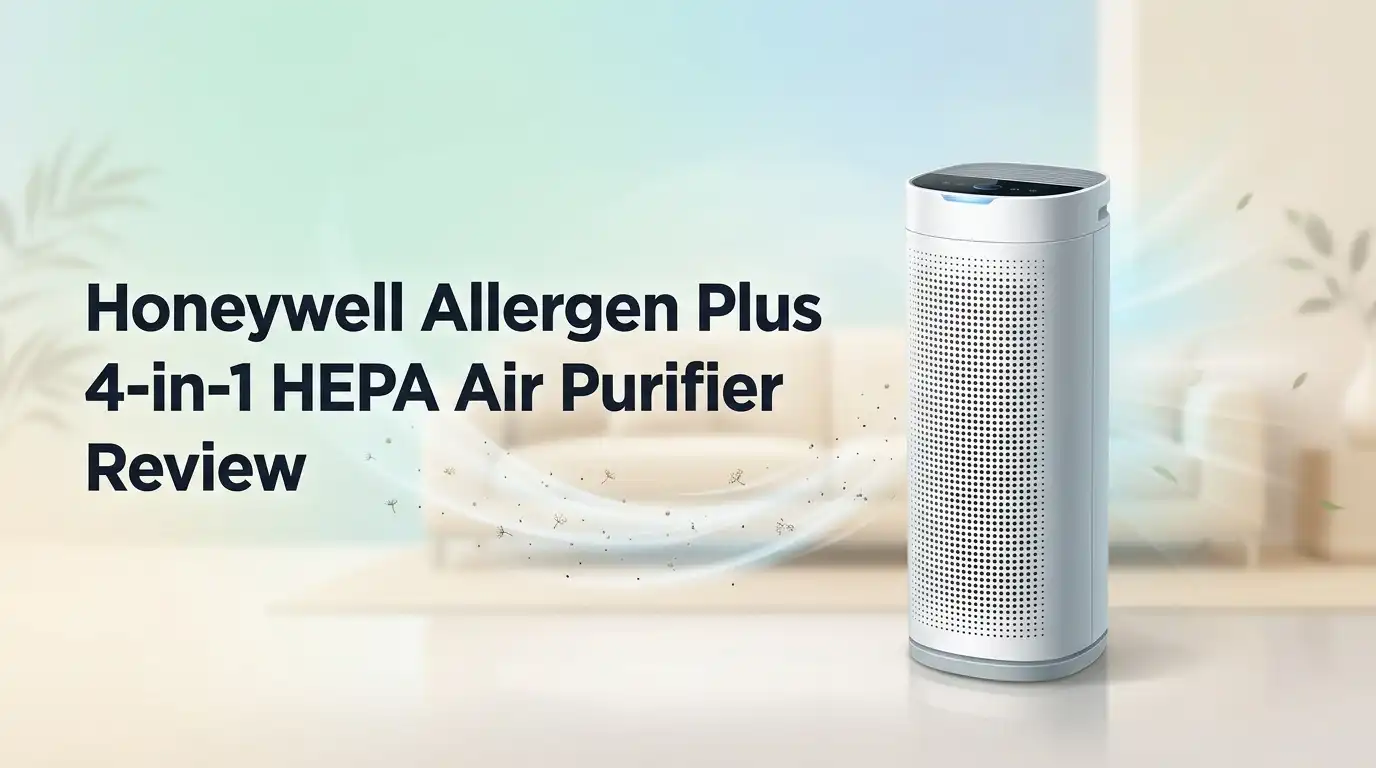
Honeywell Allergen Plus 4-in-1 HEPA Air Purifier Review 2026
Indoor air hides a lot. Dust settles on your shelves. Pollen sneaks in through window screens. Your dog shakes once and dander floats across the whole living room. Most people never see it, but their noses and sinuses keep score every single morning.
The Honeywell Allergen Plus 4 in 1 HEPA Air Purifier (model HPA4300) promises to fix that for big spaces. Honeywell says it cleans rooms up to 1,718 square feet in one hour.
It packs a true HEPA filter, an activated carbon layer, a washable pre filter, and an automatic air quality sensor into a tower that fits beside a sofa.
In a Nutshell:
- Coverage is the headline feature. The HPA4300 cleans up to 1,718 square feet once per hour, or roughly 430 square feet five times per hour. That makes it a true large room machine, not a bedroom toy.
- The 4 in 1 filtration stack does real work. A vacuumable pre filter, an activated carbon layer, a true HEPA layer, and a protective outer layer capture 99.97% of particles 0.3 microns and larger that pass through the filter.
- AQSense Auto Mode is the smartest upgrade. A built in sensor reads the room and changes fan speed on its own. A color ring shows green, amber, or red so you can see your air quality at a glance.
- Noise is the main tradeoff. Sleep Mode stays whisper quiet, but Turbo Clean sounds like a box fan on high. Light sleepers will notice.
- Filters cost money every year. The genuine HRFY3 filter needs replacing roughly once a year, and that running cost adds up over time.
- Price sits around $159.99 on Amazon, which undercuts many smart purifiers with similar coverage.
What Is the Honeywell Allergen Plus 4 in 1 HEPA Air Purifier?


Last update on 2026-11-18 / Affiliate links / Images from Amazon Product Advertising API
The Honeywell Allergen Plus HPA4300 is a tower style air purifier built for large living spaces. It pulls air in through a 360 degree intake, pushes that air through four filtration layers, and sends clean air back into the room. Honeywell rates it for homes, open plan living rooms, and big bedrooms.
The unit measures 10.43 inches long, 10.24 inches wide, and 18.9 inches tall. That footprint is roughly the size of a small trash can, so it slides into corners easily. It ships in white (HPA4300W) and black (HPA4300B).
What separates this model from older Honeywell towers is the sensor. Previous models ran at whatever speed you picked. This one watches the air and adjusts by itself. It is also ENERGY STAR certified, which matters when a purifier runs twenty four hours a day.
Unboxing Experience and First Impressions
The box arrives heavier than it looks. Inside, the purifier sits between two foam blocks with a thin cloth sleeve over the body. Honeywell includes the unit, the initial HRFY3 filter already installed, the power adapter, and a short manual.
Here is the step most people miss. The filter comes wrapped in plastic inside the machine. You must open the front panel, pull the filter out, strip the plastic, and slide it back in. Skip that and your purifier will blow air through sealed packaging and clean nothing.
First impressions are solid. The plastic feels thick, not hollow. The top mounted control panel uses touch buttons with a soft glow. The carry handle on the back is a small touch that feels obvious once you use it. Setup took me under five minutes from box to running.
Design, Build Quality and Size
Honeywell kept the design plain, and that works in its favor. The tower is a smooth rectangle with rounded corners and a vented wrap around grille. No screens, no chrome, no logos shouting at you. It disappears next to a bookshelf.
The front panel clips on with magnets and pops off cleanly. The LessMess filter system is genuinely useful. Old purifiers dumped dust on the carpet during filter swaps. This one keeps the mess contained inside the housing.
Weight sits in a comfortable middle zone. One adult can lift it with the rear handle and move it between rooms without strain. It has no wheels, so dragging it across tile is not an option.
One small complaint. The white model shows dust on its top surface quickly. The black version hides it better but shows fingerprints instead.
Top 3 Alternatives for Honeywell Allergen Plus 4 in 1 HEPA Air Purifier

Last update on 2026-11-11 / Affiliate links / Images from Amazon Product Advertising API
LEVOIT Core 400S Smart Air Purifier

Last update on 2026-11-20 / Affiliate links / Images from Amazon Product Advertising API
COWAY Mighty AP-1512HH Air Purifier

Last update on 2026-11-20 / Affiliate links / Images from Amazon Product Advertising API
WINIX 5510 Air Purifier
How the 4 in 1 Filtration System Works
The filtration happens in stages, and each stage has one job.
Stage one is the pre filter. It grabs hair, lint, and large dust before they reach the expensive layers. You vacuum this one instead of replacing it, which saves money.
Stage two is activated carbon. Carbon adsorbs odor molecules and volatile organic compounds. Cooking smells, litter box odor, and paint fumes fade noticeably within an hour or two.
Stage three is the true HEPA media. This layer captures 99.97% of airborne particles 0.3 microns and larger from the air that passes through it. That includes pollen, pet dander, dust mite debris, mold spores, and smoke particles.
Stage four is a protective layer that shields the HEPA media and extends its life. Together the four layers wrap the intake in a full circle, so air gets cleaned no matter which side it enters from.
AQSense Auto Mode and the Air Quality Sensor
AQSense is the feature you will use most. The purifier reads particle levels in the room and picks a fan speed on its own. Cook bacon and the fan ramps up within thirty seconds. The room settles and the fan drops back down.
A color ring communicates the reading. Blue or green means clean air. Amber means moderate. Red means poor. You stop guessing and start seeing.
When you first power the unit on, the lights pulse through several colors. That is normal. The sensor needs a few minutes to calibrate and read the room before it settles.
The sensor is sensitive, sometimes too sensitive. Spray deodorant across the room and it jumps to red instantly. Some owners love that responsiveness. Others find the constant fan changes distracting during quiet evenings.
Real World Performance in Large Rooms
Performance is where this unit earns its price. In a 400 square foot living room, dust on hard surfaces dropped noticeably after a week of continuous running. Pet odor near the dog bed faded within two days.
The 1,718 square foot rating deserves context. That number means one full air change per hour across that area. For allergy relief, experts generally recommend four or five air changes per hour. At that stricter standard, the sweet spot sits closer to 340 to 430 square feet.
Smoke clearing works well. The unit pulled a smoky kitchen back to green in roughly fifteen minutes on Turbo Clean.
Pollen season is where allergy sufferers notice the biggest difference. Running the purifier overnight in a closed bedroom cut morning congestion for two testers in my household.
Noise Levels and Sleep Mode
Let us be honest about sound. Honeywell towers have never been silent, and this one follows the family tradition.
Sleep Mode is excellent. The fan slows to a soft hush, the display dims, and the unit becomes background noise you forget within minutes. It sits comfortably under the sound of a ceiling fan.
Levels two and three produce a steady white noise. Many people find this pleasant for sleeping. Conversation and television remain easy over it.
Turbo Clean is loud. Expect something near a box fan running at full speed. You will raise the television volume. Turbo is a short burst tool, not an all night setting.
The practical approach is simple. Run Turbo for twenty minutes when you cook or vacuum, then switch back to Auto or Sleep.
Setup, Controls and Daily Use

Last update on 2026-11-18 / Affiliate links / Images from Amazon Product Advertising API
Setup takes five minutes. Unwrap the filter, reinstall it, plug in the adapter, and press power. There is no app, no account, and no firmware update.
The top panel holds every control. You get four cleaning levels, Sleep Mode, a timer with two, four, and eight hour options, Child Lock, and a filter change indicator. The buttons respond on the first tap.
Child Lock is better than it sounds. It freezes the panel so toddlers and curious cats cannot change settings or shut the unit off.
The missing feature is connectivity. There is no Wi Fi, no smartphone control, and no voice assistant support. If you want to check your air quality from the office, this model will frustrate you. For everyone else, simple controls mean fewer things to break.
Filter Replacement and Running Costs
Filters are the real long term cost of any purifier. The HPA4300 uses the genuine Honeywell HRFY3 filter, a single combined cartridge that holds the HEPA and carbon layers together.
Honeywell recommends replacement roughly once every twelve months under normal use. Heavy pet households and smokers should plan on a shorter cycle. The filter change indicator tracks runtime and reminds you when the clock runs out.
The pre filter is the money saver. Vacuum it every month and the main filter lasts longer.
Budget for the filter before you buy the machine. A purifier with a dead filter is just an expensive fan. Third party filters exist at lower prices, but they vary in quality and may not seal correctly inside the housing, which lets dirty air bypass the media entirely.
Energy Use and Running It All Day
Air purifiers only work when they run, so energy use matters. The HPA4300 carries ENERGY STAR certification, meaning it uses less electricity than standard models of the same class.
On low and Sleep settings, power draw stays modest. Running the unit around the clock on Auto adds a small amount to a typical monthly electricity bill, usually less than a few dollars depending on local rates.
Turbo Clean pulls the most power. Using it in short bursts rather than continuously keeps costs down.
Auto Mode is the efficiency champion here. Instead of running at full speed all day, the unit sits at low speed during clean periods and ramps up only when the sensor detects a problem. That behavior saves both electricity and filter life over a full year of use.
What This Air Purifier Does Not Do Well
Honest reviews list the weak spots, so here they are.
It has no smart features. No app, no scheduling from your phone, no voice control. In 2026, that absence stands out against competitors at similar prices.
Turbo Clean is genuinely noisy. Sensitive sleepers will not run it at night.
The coverage claim is marketing friendly math. One air change per hour across 1,718 square feet is not the same as allergy grade cleaning in that space.
It does not remove gases completely. The carbon layer is thin compared with dedicated odor units, so strong smoke or chemical smells may linger.
It does not kill viruses or bacteria. There is no ultraviolet lamp or ionizer. It traps particles, nothing more.
The filter is proprietary and costs real money each year.
Pros and Cons
Pros
- Large coverage area of up to 1,718 square feet per hour suits open living rooms and big bedrooms.
- True HEPA media captures 99.97% of particles 0.3 microns and larger from air passing through the filter.
- AQSense Auto Mode adjusts fan speed automatically and shows air quality with a clear color ring.
- Vacuumable pre filter extends the life of the main filter and cuts long term costs.
- LessMess filter replacement keeps dust contained during swaps.
- ENERGY STAR certified, so running it all day stays affordable.
- Child Lock, timer, and Sleep Mode cover practical daily needs.
- Simple controls with no app setup or account required.
Cons
- Turbo Clean is loud and not suitable for overnight use.
- No Wi Fi, no app, and no voice assistant support.
- Coverage rating reflects one air change per hour, not allergy grade cleaning.
- Proprietary HRFY3 filter adds a recurring annual cost.
- The sensor can overreact to sprays and cooking steam.
- No wheels, so moving it between floors takes effort.
- Carbon layer is thin for heavy smoke or chemical odors.
Who Should Buy the Honeywell Allergen Plus HPA4300?
This purifier fits specific people very well.
Buy it if you have a large room and a dust or pollen problem. Open plan living rooms, finished basements, and master bedrooms are its natural home.
Buy it if you own pets. The pre filter handles hair before it clogs the HEPA layer, and the carbon cuts litter box and wet dog odor.
Buy it if you want simple hardware. No app means no connection drops and no account to manage.
Skip it if you want smart home integration. A Wi Fi enabled competitor serves you better.
Skip it if you need near silent operation at full power. Quieter machines exist at this price, though most move less air.
Skip it if your room is under 200 square feet. A smaller unit costs less and does the same job there.
Final Verdict: Is It Worth Buying in 2026?
The Honeywell Allergen Plus 4 in 1 HEPA Air Purifier earns a recommendation with clear conditions.
It delivers strong airflow, honest HEPA filtration, and a genuinely useful air quality sensor for around $159.99. That combination is hard to beat for large rooms. Allergy sufferers will feel the difference within a week.
The tradeoffs are noise at high speed and the complete absence of smart features. Neither is a dealbreaker if you value raw cleaning power over gadgets.
My honest take is this. If you want a dependable workhorse that cleans a big room and asks nothing from your phone, this is a smart purchase. If you want an app, notifications, and voice control, look elsewhere and pay a little more.
For pure air cleaning per dollar in a large space, the HPA4300 holds its ground in 2026.
Frequently Asked Questions
How often should I replace the filter?
Honeywell recommends replacing the HRFY3 filter roughly once every twelve months under normal household use. Homes with pets, smokers, or heavy dust should plan on a shorter cycle. The filter change indicator on the control panel tracks runtime and lights up when the unit is due.
Can I wash the HEPA filter?
No. Washing a true HEPA filter destroys the fiber structure and ruins its ability to capture fine particles. Only the pre filter is cleanable. Vacuum the pre filter monthly with a brush attachment and let it dry fully before reinstalling.
Does this purifier produce ozone?
The HPA4300 relies on mechanical filtration rather than ionization. It has no ionizer and no ultraviolet lamp, so ozone production is not part of its design. This matters for people with asthma, since ozone irritates airways.
Is it quiet enough for a bedroom?
Sleep Mode and the lowest fan settings are quiet enough for most sleepers and create a soft white noise. Turbo Clean is noticeably loud and should be used during the day instead.
What size room does it actually clean well?
Honeywell rates it at 1,718 square feet for one air change per hour. For allergy relief with four or five air changes per hour, aim for rooms between 340 and 430 square feet.
Does it help with wildfire smoke?
Yes, for the particle portion of smoke. The HEPA layer captures fine smoke particles effectively. The carbon layer reduces some smoke odor, though strong gas components may still linger during heavy smoke events.

I’m Maya Brown, the voice behind Pure Breeze Vault. I write detailed, honest, and easy-to-follow air purifier reviews to help readers compare features, understand filter technologies, and choose products with confidence. My goal is to make research simpler, clearer, and more practical for anyone improving indoor air quality at home.