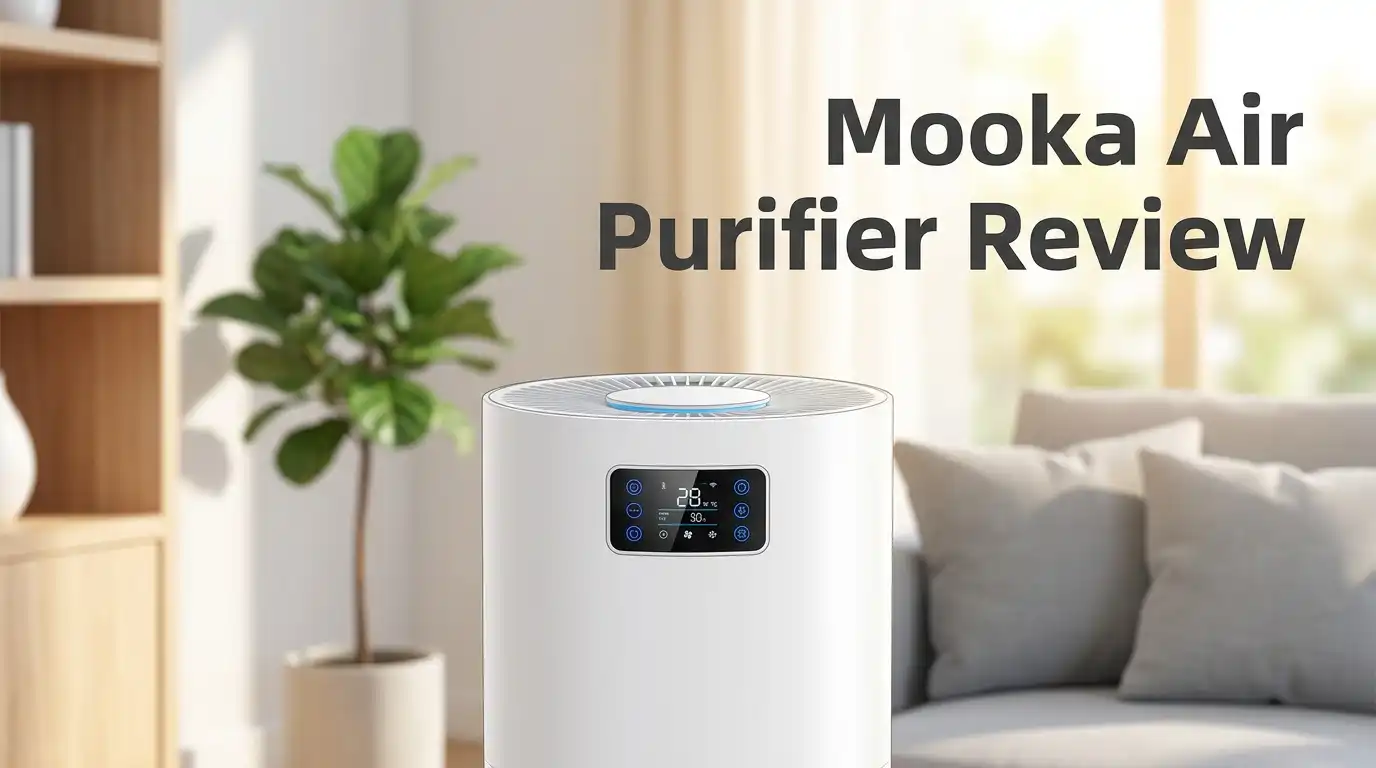
Mooka Air Purifier Review 2026: Worth Buying?
Clean air feels invisible until you lose it. Then you notice the dust on your nightstand, the stuffy nose every morning, and the smell of last night’s dinner still hanging in the kitchen. Mooka promises to fix all of that for less than the price of a decent dinner out, and thousands of Amazon shoppers buy one every single month.
That popularity raises a fair question. Is Mooka a genuine bargain, or just clever marketing with big square footage claims printed on the box? I spent time with the brand’s two most popular units, dug into independent lab testing, and read through hundreds of owner complaints to find out.
This review covers the good, the mediocre, and the parts Mooka would rather you skip. No sponsored fluff. You will learn what these purifiers actually clean, how loud they get at 2 a.m., what the filters really cost each year, and which competitors beat Mooka at its own game. Let’s get into it.
In A Nutshell:
- Mooka is a budget brand that delivers real particle filtration. Independent testing on the B-D02L showed an 87% reduction in PM2.5 particles inside a 120 square foot room after 60 minutes on high. That is respectable for a unit in this price class, though several rivals scored higher.
- The square footage claims are inflated. Mooka advertises coverage up to 1076, 2200, and even 2800 square feet. Those numbers assume a single air change per hour, which does almost nothing for allergies. Treat the advertised area as roughly one third of reality.
- These units are genuinely quiet. Sleep mode measured 40.7 dBA, quieter than many Levoit models. Light sleepers will appreciate this more than any other feature.
- Odor and smoke removal is the weak spot. Mooka uses a carbon coated fiber sheet instead of loose carbon pellets, so cooking smells, VOCs, and cigarette smoke linger far longer than particles do.
- Running costs are tiny. The small model draws just 15W on high, adding about $1.32 per month to your power bill. Filters run $20 to $40 every three to six months, which is where the real cost hides.
- No ozone, and CARB certified. There is no ionizer, no UV lamp, and no plasma mode, so nothing harmful gets pumped into your bedroom.
What Is Mooka And Should You Trust The Brand?

Last update on 2026-10-04 / Affiliate links / Images from Amazon Product Advertising API
Mooka is a newer manufacturer that sells almost exclusively through Amazon and its own web store. The company focuses on small to midsize HEPA purifiers priced between $40 and $90, which puts it directly against Levoit, Aroeve, and Afloia.
The brand carries a 4.5 star average across thousands of reviews, and its best sellers move 7,000 to 8,000 units per month. That volume tells you people are happy at the price.
Transparency is the sticking point. Mooka is not listed with Energy Star or AHAM, so its CADR figures are self reported and unverified. One independent tester contacted the company several times asking for clear CADR data and never received a straight answer.
That does not make Mooka a bad product. It does mean you should weigh lab tests and owner feedback more heavily than the spec sheet.
MOOKA Air Purifier B-D02L Review
The B-D02L is Mooka’s signature model and the one most people mean when they say “Mooka air purifier.” It is a small white or black cylinder measuring 7.1 by 7.1 by 11.5 inches and weighing only 3.52 pounds.
Air enters through vents at the base, passes through a three stage filter, and exits from the grille on top. Controls sit on the front and the crown. You get four fan speeds, a 1, 2, 4, or 8 hour timer, a child lock, and a soft amber night light.
Mooka claims 1076 square feet of coverage. Real world testing suggests 150 to 200 square feet is the honest limit for meaningful air changes. Inside a bedroom or home office it performs well. Inside an open living room it struggles.
The plastic feels solid without feeling premium. Build quality matches the price, which is fair.
Unboxing Experience And Setup
The box arrives smaller than expected, roughly the size of a large coffee canister package. Inside you find the purifier itself, one preinstalled filter, a power cord, and a thin user manual. No remote, no extra filter, no fancy inserts.
Setup takes about two minutes. Twist off the bottom cover, slide out the filter, peel away the plastic wrap, and slide it back in. Skipping this step is the single most common owner mistake, and it makes the unit seem broken because airflow drops to almost nothing.
Plug it in, tap the top button, and it runs. There is no app, no pairing, and no account signup.
One small touch I liked: the unit remembers your last fan speed and light setting after a power cut, which makes it work nicely with a smart plug for scheduling.
Top 3 Alternative for Mooka Air Purifier


Last update on 2026-10-05 / Affiliate links / Images from Amazon Product Advertising API
Levoit Core 300 Air Purifier

Last update on 2026-10-03 / Affiliate links / Images from Amazon Product Advertising API
Winix 5510 Air Purifier

Last update on 2026-10-03 / Affiliate links / Images from Amazon Product Advertising API
Coway Airmega Mighty AP-1512HH Air Purifier
MOOKA PR1 Large Room Air Purifier Review

Last update on 2026-10-04 / Affiliate links / Images from Amazon Product Advertising API
The PR1 is the step up model and Mooka’s current Amazon favorite, with 8,000 plus monthly sales. It targets pet owners and larger spaces.
The big upgrades are a PM2.5 laser sensor with a numeric display, a true Auto mode that adjusts fan speed on its own, and a washable dual pre filter that traps pet hair before it clogs the HEPA layer. That washable layer alone saves real money over a year.
It also runs a four stage filtration path instead of three, adding extra activated carbon for litter box and kitchen odors.
Mooka advertises 2200 square feet. Again, halve that number at minimum if you want allergy relief rather than marketing math. In a 300 to 400 square foot bedroom the PR1 clears visible dust haze quickly.
If you own cats or dogs, the PR1 is the model worth paying extra for.
How The Filtration System Actually Works
Every Mooka uses the same basic three layer sandwich, and understanding it explains both the strengths and the gaps.
The pre filter is a nylon mesh bonded to the outside of the cartridge. It grabs hair, lint, and large dust. On the PR1 this layer is washable. On the B-D02L it is not.
The H13 HEPA layer does the heavy lifting. It captures 99.97% of particles down to 0.3 microns, which covers pollen, dust mite debris, mold spores, and fine smoke particles.
The activated carbon layer handles smells. Here is the honest problem: Mooka uses a carbon coated fiber sheet rather than granular pellets. There is simply less carbon mass, so odor absorption saturates fast.
There is no ionizer and no UV lamp, so no ozone reaches your lungs. That is a genuine safety win over several cheap competitors.
Real Performance Test Results
Numbers beat adjectives, so here is what controlled testing produced on the B-D02L running at maximum speed.
In a 120 square foot room, PM2.5 dropped from 100 to 12.1 micrograms per cubic meter in 60 minutes. AQI fell from 131 to 17. That is an 87% improvement.
In a 194 square foot room, PM2.5 fell from 105.6 to 19.5 micrograms, an 81% improvement over the same hour.
For context, the Blueair Mini Max hit 92% in the identical small room, while the Aroeve MK01 managed 86% and the Levoit LV-H126 reached 85%. Mooka sits mid pack, slightly above the cheapest rivals and clearly below premium units.
Smoke clearance inside a sealed glass chamber was the weakest result. Particles vanished, but the smell did not.
Noise Levels Through A Full Day
This is where Mooka quietly wins. Measured output across four speeds looked like this.
Sleep mode registered 40.7 dBA, low speed hit 45.9 dBA, medium reached 52.2 dBA, and high climbed to 61.1 dBA.
That sleep figure is important. The Levoit LV-H132 measures 43.1 dBA at its lowest setting, so Mooka is audibly quieter where it counts most. The sound is a smooth low whoosh with no motor whine or rattle.
High speed is a different story. 61 dBA is loud enough to interrupt a conversation or a video call. You will not sleep through it, and you will reach for the remote you do not have.
My practical advice: run medium during the day and sleep mode overnight. Reserve high for cooking or post vacuum cleanup only.
Power Use And Running Costs
Mooka is cheap to own, and this deserves credit.
The B-D02L uses a 16W motor. Real draw measured 1.2W on standby, 2.8W in sleep mode, 5.1W on low, 8W on medium, and 15W on high.
Running it 24 hours a day on maximum for a full month costs roughly $1.32 at 12 cents per kilowatt hour. On sleep mode that falls to about 25 cents. You could run it continuously for a year and barely notice the bill.
Larger models like the PR1 and KJ190H draw more, but still stay well under typical tower purifiers.
The electricity is nearly free. The filters are not. That distinction matters when you calculate true cost of ownership, which the next section covers honestly.
Filter Replacement Costs Over A Year
Here is the hidden expense. Mooka recommends replacing filters every three to six months.
Genuine replacements run roughly $20 to $25 for the B-D02L and around $26 to $40 for the PR1. Buy four per year for a small unit and you spend $80 to $100 annually on filters for a purifier that cost about $50.
Independent testing also found the small cartridge gets dirty faster than the recommended interval suggests, especially in homes with pets.
Two ways to cut this. Vacuum or wipe the pre filter mesh every two weeks, which meaningfully extends HEPA life. And choose a model with a washable pre filter, like the PR1 or KJ190H, so hair never reaches the paid layer.
Third party filters exist and cost less, though fit and sealing quality vary.
What Mooka Does Not Do Well
Authentic reviews name the flaws, so here they are without softening.
Odor removal disappoints. Frying fish, cigarette smoke, and strong VOCs outlast the thin carbon sheet. If smells are your main problem, look elsewhere.
Coverage claims are unrealistic. A 1076 square foot rating on a unit this small only works at one air change per hour. Allergy sufferers need four or more.
No published CADR verification. Nothing from AHAM or Energy Star backs the airflow figures.
No app, no voice control, no auto mode on the base model. The B-D02L lacks an air quality sensor entirely, so it cannot react to your room.
Customer support is inconsistent. Testers and owners both report slow or vague responses to technical questions.
The warranty runs just one year, shorter than the three years Coway offers.
Pros And Cons Of Mooka Air Purifiers
Here is the balanced summary after all the testing and reading.
Pros
- Excellent price and among the cheapest true HEPA purifiers available
- Very quiet at low speeds, with sleep mode at 40.7 dBA beating many rivals
- Strong particle removal, reaching 81% to 87% PM2.5 reduction in one hour
- No ozone output, plus CARB certification for safety
- Extremely low power draw, roughly $1.32 per month on maximum
- Useful extras including timer, child lock, night light, and aromatherapy pads on some models
- Washable pre filters on the PR1 and KJ190H reduce long term filter spend
- Light and portable, easy to carry between rooms
Cons
- Weak odor, smoke, and VOC performance because of the thin carbon layer
- Overstated room coverage on every model in the lineup
- Unverified CADR figures with no AHAM or Energy Star listing
- Filter costs add up fast relative to the purchase price
- No smart features on the entry model, and no remote control
- Only a one year warranty
- High speed is loud at 61.1 dBA
Who Should Buy A Mooka Air Purifier?
Mooka fits a specific buyer very well and disappoints everyone else.
Buy it if you need clean air in a bedroom, dorm, nursery, or home office under 250 square feet. Buy it if you are a light sleeper who values silence over specs. Buy it if you want a second or third purifier for a spare room without spending $200. Buy it if seasonal pollen or household dust is your enemy.
Skip it if you are managing wildfire smoke, chemical sensitivity, or heavy cooking odors. Skip it if you want app control, verified CADR data, or a long warranty. Skip it if you plan to clean an open plan living space with one machine.
Budget honesty matters here. At $45 the Mooka is a smart purchase. At $90 you start competing with better documented machines.
Final Verdict: Is Mooka Worth It In 2026?
Mooka earns a solid recommendation with clear boundaries. The particle filtration works, the noise floor is genuinely low, and the running cost is almost nothing. For dust, pollen, and pet dander inside a normal bedroom, it does the job it was bought to do.
The brand loses points for marketing rather than engineering. Coverage numbers are exaggerated, CADR data is unverified, and the carbon layer is too thin to handle real odors. Those are the compromises you accept for the price.
My score: 7.5 out of 10 for the B-D02L and 8 out of 10 for the PR1, which fixes the sensor and pre filter gaps.
If you want the best small purifier regardless of cost, the Levoit Core 300 or Coway Mighty are stronger. If you want the most clean air per dollar, Mooka is hard to beat.
Frequently Asked Questions
Does the Mooka air purifier produce ozone?
No. Mooka units contain no ionizer, no UV lamp, and no plasma generator. The brand holds CARB certification, which confirms ozone output stays within safe limits. This makes Mooka a safer choice than several budget purifiers that include ionizers by default.
How often should I change the Mooka filter?
Mooka recommends every three to six months. Homes with pets or smokers should aim for the shorter end. An indicator light reminds you when the timer expires. Vacuum the mesh pre filter every two weeks to stretch the life of the HEPA layer.
Can a Mooka air purifier really cover 2200 square feet?
Not in any practical sense. That figure assumes one air change per hour, which barely helps allergies. For four air changes per hour, expect closer to 400 to 550 square feet from the PR1 and around 200 square feet from the B-D02L.
Does Mooka remove cooking smells and cigarette smoke?
Partially. It captures smoke particles well, but the carbon coated fiber sheet holds limited odor capacity. Strong kitchen smells and tobacco smell tend to linger. A purifier with granular carbon pellets performs far better for odor control.
Is the Mooka air purifier quiet enough for sleeping?
Yes. Sleep mode measures about 40.7 dBA and switches off all LED lights within ten seconds. That is quieter than several Levoit models at their lowest setting. Avoid running high speed overnight, since it reaches 61 dBA.
Are third party Mooka filters safe to use?
They work, and they cost less. The tradeoff is inconsistent sealing and thinner media, which can reduce efficiency and let air bypass the filter. Genuine filters guarantee proper fit. Many owners split the difference by alternating between the two.

I’m Maya Brown, the voice behind Pure Breeze Vault. I write detailed, honest, and easy-to-follow air purifier reviews to help readers compare features, understand filter technologies, and choose products with confidence. My goal is to make research simpler, clearer, and more practical for anyone improving indoor air quality at home.