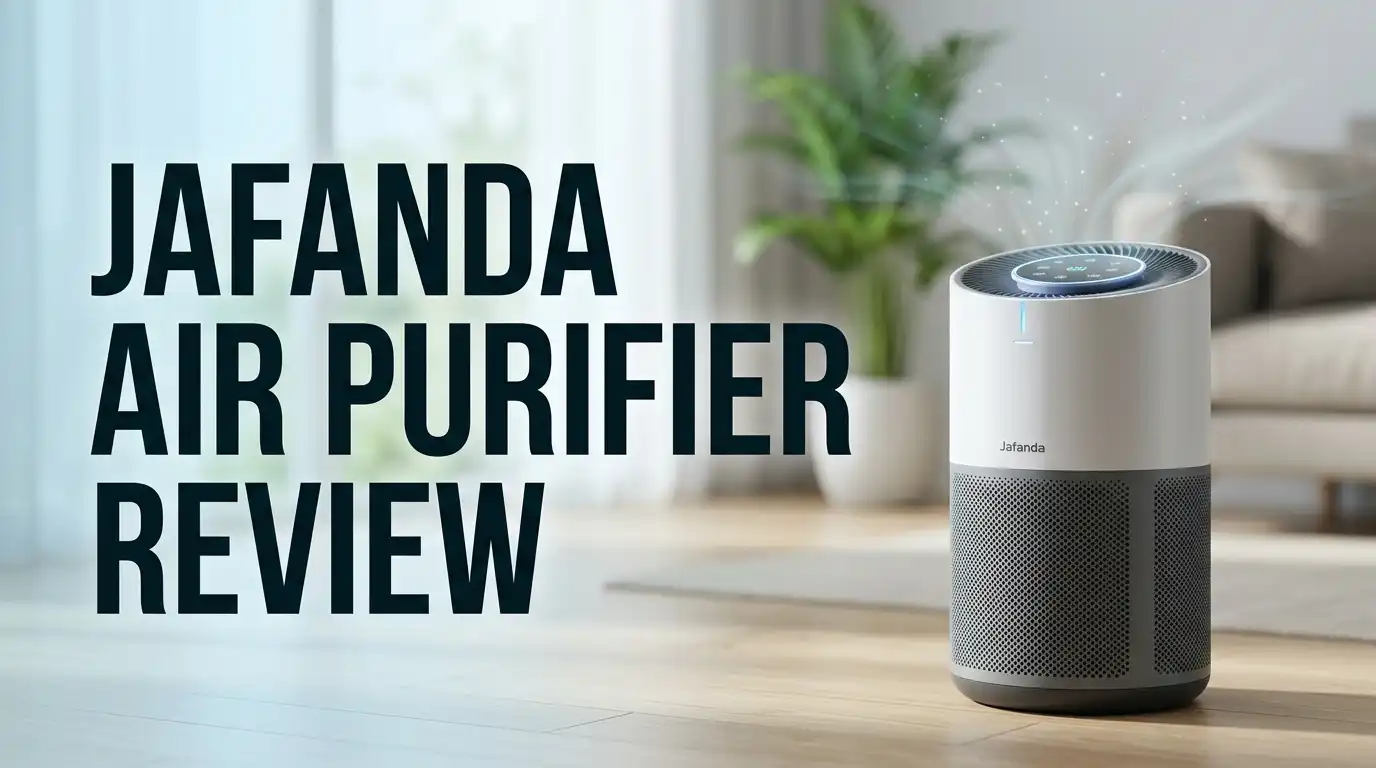
Jafanda Air Purifier Review 2026: Worth Buying?
Clean indoor air feels like a luxury until you actually breathe it. Most people only notice their air after a dusty week, a wildfire warning, or a cat that sheds everywhere. That is usually the moment the search for an air purifier begins.
Jafanda sits in an interesting spot. The brand is less famous than Levoit or Coway, yet it sells big units with serious carbon filters at prices that undercut the big names. That combination draws attention fast.
This review covers what Jafanda gets right, what it gets wrong, and whether the savings actually hold up after a year of use. No marketing fluff, just the practical details you need before spending money.
In a Nutshell:
- Jafanda is a legitimate value brand. The lineup spans eight models covering 450 sq ft up to 3,800 sq ft. Every model uses True HEPA 13 plus activated carbon, and the units carry ETL, Energy Star, CARB, EPA, FCC, and ECARF certifications. That certification stack is unusually wide for a budget brand.
- The carbon filters are the real selling point. The JF888 ships with roughly 2.12 lb of activated carbon, and upgraded filters push past 4 lb. Most competitors use a thin carbon sheet that weighs a few ounces.
- The PM2.5 sensors are the weak link. Multiple owners report sluggish readings. Dust tossed in front of the sensor barely registers. Auto mode becomes unreliable as a result.
- Noise levels are genuinely excellent. Sleep mode runs near 22 dB on most models, which is quieter than a whisper and fine for light sleepers.
- Coverage claims are optimistic. The 3,800 sq ft rating on the JF888 assumes only one air change per hour. For allergy relief, size the unit for roughly half that space.
- Value depends on your priority. Buy Jafanda for carbon capacity and quiet operation. Skip it if you want a precise, responsive air quality sensor.
What Is the Jafanda Air Purifier?
No products found.
Jafanda is an air purifier brand that sells direct to consumers and through Amazon. The company markets German engineering, though the machines are manufactured in China. The lineup includes eight active models split across four categories: small room, portable, large room, and smart WiFi.
Every unit shares the same core recipe. A washable pre filter catches hair and lint. An H13 True HEPA layer traps particles down to 0.3 microns at 99.97% efficiency. An activated carbon bed then adsorbs odors, smoke, and VOCs.
The brand’s whole identity rests on that third stage. Jafanda packs far more carbon into its filters than most rivals at the same price. For households dealing with cooking smells, pets, or seasonal smoke, that extra mass matters more than any smart feature.
Jafanda JF888 Review: The Flagship Large Room Unit
The JF888 is the model most buyers end up considering. It covers up to 3,800 sq ft with a dust CADR of 488 CFM, which is high output for a home machine. Dual DC brushless motors pull air through filters on both sides of the tower.
The unit stands 25.9 inches tall and weighs just under 20 pounds. Caster wheels on the base make it easy to roll between rooms, which is a thoughtful touch at this size. Five fan speeds, a child lock, and a touch panel handle the basics.
Real world performance is strong on dust and pollen. Owners consistently report visibly filthy filters at replacement time, which means the machine is doing its job. Maximum draw is 90W, though auto mode and lower speeds pull far less.
Unboxing Experience: What Actually Arrives
The JF888 arrives in a tall double wall carton with molded foam caps on both ends. The machine sits upright inside a cloth bag, and the casters are already attached. No assembly tools are required.
Inside the box you get the purifier, two filters already seated in their side compartments, a short power brick, and a folded quick start sheet. The manual is thin but readable.
One step trips up almost every new owner. Both filters ship wrapped in sealed plastic. You must pop open the side panels, pull each filter out, strip the wrapping, and reseat them. Skip this and airflow drops to nearly nothing.
Total setup time runs about five minutes. WiFi pairing through the Jafanda app takes another three. The fit and finish feel solid for the price, with no rattles or flimsy panels.
Jafanda JF260 Review: The Quiet Bedroom Option
No products found.
The JF260 is the compact alternative for people who do not need whole home coverage. It stands 14.41 inches tall, weighs 6.6 pounds, and covers up to 1,190 sq ft at one air change per hour. Dust CADR sits at 153 CFM.
This model drops the smart features entirely. No WiFi, no app, no auto mode. You get five manual fan speeds, a sleep mode, an air quality indicator light, and a soft night light.
That simplicity is a feature for some buyers. There is nothing to pair, nothing to update, and nothing to troubleshoot. Noise drops to 23 dB on the lowest speed, which disappears into room ambience.
Honest sizing advice: treat it as a 400 to 600 sq ft machine if you want meaningful air turnover rather than the headline number.
Top 3 Alternative for Jafanda Air Purifier


Last update on 2026-10-06 / Affiliate links / Images from Amazon Product Advertising API
LEVOIT Core 400S Smart Air Purifier

Last update on 2026-10-06 / Affiliate links / Images from Amazon Product Advertising API
COWAY Airmega Mighty Air Purifier

Last update on 2026-10-06 / Affiliate links / Images from Amazon Product Advertising API
WINIX 5510 True HEPA Air Purifier
How the Filtration System Works
Air enters through perforated side panels and hits the pre filter first. This layer grabs pet hair, lint, and visible dust. You can vacuum it, which extends the life of everything behind it.
The H13 HEPA layer comes next. H13 is a medical grade classification that captures 99.95% or more of particles at the most penetrating size. Jafanda rates its filters at 99.97% down to 0.3 microns, with partial capture well below that.
The activated carbon bed finishes the job. Carbon works through adsorption, not filtration. Gas molecules stick to the porous surface of the carbon granules rather than being physically strained out.
More carbon means more surface area and longer useful life. This is exactly where Jafanda beats cheaper competitors that use a carbon dusted mesh instead of loose granules.
Noise Levels and Sleep Mode Performance
Noise is where Jafanda quietly outperforms its price tier. Sleep mode on the JF888, JF260, and JF500 all measure around 22 to 23 dB. For reference, a quiet library sits near 30 dB.
On speed one or two, the sound is a low, even airflow hum with no motor whine. Several owners describe it as useful white noise rather than a distraction.
Speeds four and five are a different story. Push the JF888 to maximum and it becomes clearly audible, roughly the level of a bathroom fan. That is normal for any purifier moving 488 CFM, but it is worth knowing.
Sleep mode also dims the display panel. Light sleepers will appreciate this more than the decibel rating. A bright blue air quality readout at 2 a.m. ruins an otherwise quiet machine.
Smart App and Voice Control
The Jafanda app handles scheduling, fan speed, filter life tracking, and air quality history. Setup uses a standard 2.4 GHz WiFi pairing flow. Alexa and Google Assistant both work for basic commands.
The app is functional rather than polished. Menus load slowly at times, and the interface looks dated next to the VeSync app that Levoit uses. Still, everything works.
Filter life tracking is the most useful feature. Running the JF888 continuously on speed two drains roughly 14% of filter life per month, which extrapolates to about six months of service.
Remote control genuinely matters for large units. Walking across the house to change a fan speed gets old fast, and voice commands solve that cleanly.
The PM2.5 Sensor Problem
This is the part most reviews skip. Jafanda’s PM2.5 sensors are noticeably less sensitive than those in Coway or Levoit machines.
Owners have run direct tests. Tossing dust into the air in front of the sensor produces almost no reaction, while a competing purifier in the same room spikes to 240. Only candle smoke held close to the intake moves the reading meaningfully.
The practical consequence is simple. Auto mode does not ramp up when it should, so the machine may idle on low while your room is genuinely dusty.
The workaround is to ignore auto mode. Run the unit manually on speed two or three around the clock. Several long term owners do exactly this and report excellent results. You lose automation but keep the filtration.
Odor and Smoke Removal: Honest Results
Carbon capacity suggests Jafanda should crush odors. Reality is more mixed.
Cooking smells and everyday pet odor clear well. The auto sensor even reacts to kitchen vapors faster than it reacts to dust. Light smoke from a blown out candle also disappears quickly.
Heavy or persistent odors are harder. One JF999 owner reported limited improvement with wood fireplace smoke and burnt food smells, despite 3.38 lb of carbon across two filters.
The fix exists but costs extra. Jafanda sells upgraded filters containing roughly 4.4 lb of granular carbon plus SP Permanganate, which targets gases that plain carbon struggles with.
Set expectations accordingly. Jafanda is good at odors, not magical with them. Heavy smoker households should budget for the upgraded filters from day one.
Filter Replacement Costs and Maintenance
Filters last four to six months under steady use, or six to eight months with lighter duty. The unit tracks this and lights an indicator when replacement time arrives.
Maintenance is minimal. Vacuum the pre filter monthly. Wipe the sensor cover with a dry cloth every few weeks, since dust buildup makes an already dull sensor worse. Keep the machine at least 15 inches from walls.
Replacement filters are proprietary. Original two packs for the JF888 run in the mid range of filter pricing, and third party options from brands like Pureburg exist at lower cost.
Factor filter cost into your decision. A cheap purifier with expensive consumables is not actually cheap. Jafanda lands in reasonable territory here, especially given how much carbon you get per filter.
Energy Use and Running Costs
The JF888 draws a maximum of 90W at full speed. On speed two, where most owners run it, consumption drops well below that. The unit carries Energy Star certification.
Running continuously on a low or medium setting costs a few dollars per month in most regions. That is cheaper than a single incandescent bulb left on around the clock.
The DC brushless motors deserve credit here. They use less power than the AC motors in older designs and last longer with less vibration.
One caution applies. If you run the JF888 on speed four or five all day, the electricity bill becomes noticeable despite the certification. Size the machine correctly so it can loaf along on low instead.
Jafanda Model Lineup Compared
The range breaks down cleanly by room size and budget.
The JF100 covers 450 sq ft at 50 CFM and suits a small bedroom or office nook. The JF180 handles 780 sq ft at 120 CFM and adds a fragrance sponge. The JF260 and JF239 both sit near 1,100 to 1,190 sq ft.
The JF500 steps up to 2,105 sq ft with 271 CFM and four filters. Then the flagships: the JF888 at 3,800 sq ft and 488 CFM, the JF999 at 4,575 sq ft and 588 CFM, and the JF1500 at 6,862 sq ft and 882 CFM.
Pricing scales steeply at the top. The JF888 represents the best balance of capability and cost for most homes.
Pros and Cons of Jafanda Air Purifiers
Pros
- Exceptional carbon capacity compared to rivals at the same price, with 2 lb or more per filter versus a few ounces elsewhere.
- Genuinely quiet at 20 to 23 dB in sleep mode across the entire lineup, suitable for nurseries and bedrooms.
- Broad certification stack including ETL, Energy Star, CARB, EPA, FCC, and ECARF allergy recognition.
- Strong price per square foot of coverage, often undercutting Coway and Blueair for equivalent CADR.
- Easy setup and maintenance with tool free filter swaps and caster wheels on the larger towers.
- Smart features on key models including app scheduling, filter tracking, and Alexa voice control.
Cons
- Insensitive PM2.5 sensors that undermine auto mode reliability on multiple models.
- Optimistic coverage ratings based on a single air change per hour rather than the recommended four or five.
- Mixed heavy odor performance that may require buying the pricier upgraded filters.
- Dated app interface that lags behind Levoit and Coway software.
- Proprietary filters that lock you into ongoing branded purchases.
- Limited brand track record with fewer long term owner reports than established competitors.
What Jafanda Does Not Do Well
Three weaknesses deserve plain language.
First, the air quality sensor is not trustworthy. If automated response is your main reason for buying a smart purifier, this brand will frustrate you. Coway sensors react in seconds. Jafanda sensors often do not react at all.
Second, the marketing math on coverage stretches the truth. A 3,800 sq ft rating at one air change per hour is close to meaningless for allergy sufferers, who need four or five changes. Mentally halve or quarter every coverage number.
Third, brand support is thinner than the big names. Warranty is one year, returns run 30 days, and customer service runs through email rather than phone.
None of these are dealbreakers at the price. They are simply the tradeoffs you accept for the savings.
Who Should Buy a Jafanda Air Purifier?
Jafanda makes sense for specific buyers.
Pet owners benefit most. The thick carbon beds handle dander odor far better than slim competitor filters, and the pre filters catch hair before it clogs anything.
Light sleepers get near silent operation with dimmed displays at a price that undercuts premium quiet models.
People with large open floor plans get CADR figures that typically cost much more from Coway or Blueair.
Skip Jafanda if you want reliable auto mode, if you need polished app software, or if you are treating heavy chemical fumes. In those cases the Coway Airmega Mighty or Levoit Core 400S will serve you better despite higher cost per square foot.
Final Verdict
Jafanda earns a recommendation with clear conditions attached. The filtration hardware is excellent, the noise performance is class leading, and the pricing is aggressive. Long term owners running these machines around the clock report consistent satisfaction.
The sensor weakness is real but manageable. Run the unit manually on a medium speed and you get everything the brand promises on filtration while bypassing the one component that disappoints.
For 2026, the JF888 stands out as the smart buy in the lineup. It delivers 488 CFM, dual carbon filters, app control, and caster wheels for roughly what a mid tier competitor charges for half the airflow.
Buy it for the filters and the silence. Do not buy it for the automation.
Frequently Asked Questions
Is Jafanda a good air purifier brand?
Yes, with caveats. Jafanda holds ETL, Energy Star, CARB, EPA, FCC, and ECARF certifications across its lineup, which means the core safety and filtration claims have been independently verified. The hardware quality is solid and the carbon capacity exceeds most competitors. The main weakness is sensor accuracy rather than filtration.
Where are Jafanda air purifiers made?
Jafanda machines are manufactured in China. The brand references German engineering in its marketing, though the assembly and production happen in Chinese facilities. This is standard across the air purifier category, including many premium brands.
How often should I replace Jafanda filters?
Plan on four to six months with continuous use, or six to eight months with lighter use. The built in indicator tracks this automatically. Homes with pets, smokers, or heavy cooking will hit the shorter end of that range.
Does the Jafanda JF888 really cover 3,800 square feet?
Technically yes, but only at one air change per hour. For allergy and asthma relief, allergists recommend four to five air changes per hour. At that standard, the JF888 realistically covers 760 to 950 sq ft well.
Can I use third party filters in a Jafanda purifier?
Yes. Brands including Pureburg and Sakegdy sell compatible replacements for the JF888, JF999, JF180, and JF100. Quality varies, so check carbon weight specifications before buying. Original filters guarantee correct fit and carbon loading.
Is Jafanda better than Levoit or Coway?
It depends on your priority. Jafanda wins on carbon capacity, noise, and price per square foot. Coway wins on sensor accuracy and brand track record. Levoit wins on app quality and AHAM verified CADR ratings. Choose based on which weakness you can live with.
Does Jafanda produce ozone?
No. Jafanda units use mechanical filtration only, with no ionizer or UV stage on the main models. All units carry CARB certification, which California requires specifically to limit ozone emissions.

I’m Maya Brown, the voice behind Pure Breeze Vault. I write detailed, honest, and easy-to-follow air purifier reviews to help readers compare features, understand filter technologies, and choose products with confidence. My goal is to make research simpler, clearer, and more practical for anyone improving indoor air quality at home.