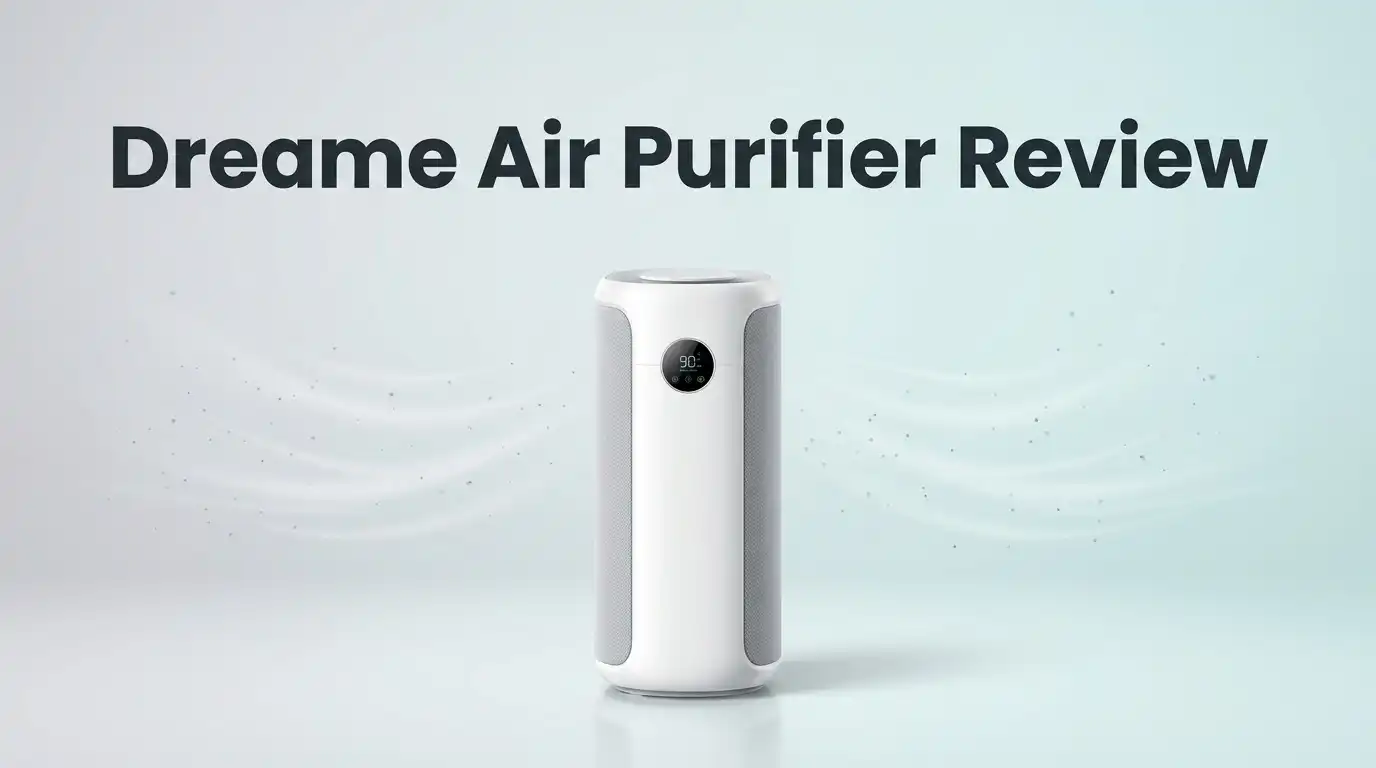
Dreame Air Purifier Review 2026: Worth Buying?
Dreame built its name on robot vacuums. Now the brand wants the air in your house too. The 2026 lineup includes the AirPursue PM20, the PM10, the pet focused FP10, and smaller units like the AP10 and TP5. Prices run from under $200 to nearly $1,000, which is a wide spread for one brand.
I spent time with the specs, the lab reports, the owner complaints on Reddit, and hands on reviews from people who lived with these machines for weeks.
Some of what I found is genuinely impressive. Some of it is marketing fluff with footnotes attached. This review covers both. You will learn what these purifiers clean, how loud they get, where the app falls apart, and whether the price tags make sense in 2026.
In a Nutshell:
- The PM20 is the flagship and it performs. Dreame rates the newer Pro version at a 500 m³/h particulate CADR with an H14 grade filter. The original PM20 sits at 400 m³/h. Both cover large open rooms well. Lab reports back the 99.99% filtration claim at 0.1 microns.
- Noise is a real strength. Reviewers measured roughly 30 to 34 dB on the lowest setting. One tester put his ear next to the unit and could not tell it was running. Max speed hits about 64 to 68 dB, which is noticeable but not harsh.
- The app is the weakest link. Multiple owners report pairing failures, dropped connections, and broken support links inside the Dreamehome app. One reviewer never got his PM20 connected at all. This is the most common complaint across every Dreame purifier model.
- The FP10 solves a real pet problem. Its Furcatch roller sweeps fur off the filter automatically. Filters last close to two years with no weekly cleaning. For multi pet homes this is the standout model.
- Build quality reports are mixed. Some owners praise the PM20. Others on Reddit flag flimsy panels and reliability issues that undercut otherwise good performance.
- Value depends entirely on sale pricing. At $999 list the PM20 is hard to justify. At $360 to $500 it competes seriously with Dyson.
What Is the Dreame Air Purifier Lineup in 2026?


Last update on 2026-10-04 / Affiliate links / Images from Amazon Product Advertising API
Dreame splits its purifiers into three families. The AirPursue series covers the PM10 and PM20, which are tall tower units for large rooms. The FP series holds the FP10, built around pet hair. The AP and TP series include the AP5, AP10, and TP5, which are smaller and cheaper.
The PM20 is the halo product. It purifies, heats, and works as a fan. The PM10 is nearly identical but drops the heater. The FP10 skips heating entirely and focuses on fur capture with a rotating filter and a cleaning roller.
Coverage claims range from around 1,346 square feet for the FP10 up to 1,883 square feet on the PM20 Amazon listing. Treat those numbers as best case lab figures. Real rooms have furniture, doorways, and corners that slow airflow considerably.
Dreame AirPursue PM20 Review
The PM20 is the model most people mean when they search for a Dreame air purifier. It stands 850 mm tall, weighs 13.6 kg, and rolls on hidden wheels. The filtration stack has four parts: a magnetic outer housing for hair and debris, a HEPA layer, an activated carbon layer, and a formaldehyde catalytic filter using manganese dioxide.
That last layer matters. Most purifiers trap formaldehyde. This one breaks it down into water and carbon dioxide. The formaldehyde CADR is rated at 250 m³/h.
Dreame also added UVC light and its PlasmaNova ion system on the Pro version. The company states the unit does not actively generate ozone and tested a 99.7% ozone removal rate in one hour. Ion systems still make some buyers nervous, so check whether you can disable it if that concerns you.
Unboxing the Dreame PM20: First Impressions
The box is heavy and awkward. At 30 pounds you will want a second person or a clear path to the room. Inside you get the main body, a remote control, and a user manual. That is it. No spare filter, no extra accessories.
The first reaction most people have is confusion about the design. One reviewer described it as a 1970s vision of a future robot, comparing it to EVE from Wall E with a wider base. It is not a neutral looking box. You either like it or you hide it.
Setup is simple. Pull the plastic wrap off the filter, slot the magnetic housing back on, plug it in, and press power. The whole process takes under five minutes. The hidden wheels make repositioning easy on hard floors, though they struggle on thick carpet.
Top 3 Alternative for Dreame AirPursue PM20

Last update on 2026-10-03 / Affiliate links / Images from Amazon Product Advertising API
Levoit Core 400S Smart Air Purifier

Last update on 2026-10-03 / Affiliate links / Images from Amazon Product Advertising API
Coway Airmega Mighty True HEPA Air Purifier
Last update on 2026-10-04 / Affiliate links / Images from Amazon Product Advertising API
Dreame Smart Air Purifier PM10
Filtration Performance: Does It Actually Clean the Air?
Here is where Dreame does well. The PM20 Pro uses an H14 grade filter, which is a step above the H13 found in most consumer units. Dreame cites an SGS test report for the 99.99% efficiency figure at 0.1 microns.
Owners confirm the practical results. Cooking smoke clears fast. Litter box odor stops hovering. Candle particulate spikes drop back to green within minutes on the app graph. One tester with two cats said dust and hair visibly stopped settling on her hardwood floors in the room running the purifier.
The sealed filter design also helps. Pollutants stay inside the housing instead of leaking back out through gaps. This is a detail cheaper purifiers skip, and it is worth paying attention to.
That said, no purifier fixes a ventilation problem. If your kitchen has no window and no vent, a purifier reduces the symptoms rather than the cause.
Dreame FP10 Furcatch Review

Last update on 2026-10-04 / Affiliate links / Images from Amazon Product Advertising API
The FP10 is the model pet owners should look at first. It stands just over two feet tall with a 14 inch diameter and a 360 degree intake vent around the base.
The headline feature is the Furcatch roller. A microfiber roller sits under the hood and flicks back and forth across the rotating HEPA filter, combing hair off automatically. The collected fur drops into a visible compartment you empty occasionally.
This means no weekly filter scrubbing and no replacement filters for roughly two years. The app counts down the remaining filter days.
Dreame also designed the flat top to hold a cat up to 33 pounds, and the unit shuts off if tipped. An adjustable LED light strip doubles as a night light. Coverage is rated at 1,346 square feet. At around $460 it costs more upfront than rivals but less over time.
Noise Levels Day and Night
Noise is where Dreame quietly beats most competitors. The PM20 is rated 34 dB at its lowest setting and 68 dB at maximum. Independent testing put the low end closer to 30 dB and the top around 64 dB.
In plain terms, the lowest two or three fan speeds are effectively silent in a normal room. Several reviewers admitted they leaned in to check whether the unit was running.
The FP10 behaves similarly. Sleep mode and low fan speeds disappear into the background. Pet Purify mode measures about 52 dB from an inch away, and the top speed reaches roughly 61 dB.
Neither unit produces the high pitched whine that makes some purifiers unbearable at night. The tone is a low hum rather than a sharp rush of air, which makes a bigger difference than the decibel number suggests.
The Dreamehome App Experience
This is the section where Dreame loses points. The app looks good on paper. You get pollutant monitoring for PM1, PM2.5, PM10, VOCs, and formaldehyde, plus temperature, humidity, scheduling, mode switching, and voice assistant links.
When it works, it is genuinely useful. The air quality graph shows spikes that line up with cooking, candles, or an open window.
When it does not work, it is frustrating. One reviewer connected to his router but never completed pairing with the Dreame network, and the in app support link failed too. Owners of the AP10 report similar problems in user groups, with enough volume that app reliability shows up repeatedly in Google reviews.
If app control is essential to your purchase, know that this is a coin flip. The remote and onboard controls work fine either way.
Smart Sensors and Enviro Detect
The PM20 carries a seven sensor array. It tracks PM1, PM2.5, PM10, formaldehyde, TVOC, temperature, and humidity. Readings appear on the onboard LCD and in the app.
Enviro Detect is the feature people talk about most. The purifier uses radar to find a person in the room and aims the airflow at them, following movement within about 5 meters across a 120 degree arc. If two people are present, it oscillates instead.
It feels gimmicky until you sit in front of it and notice the steady stream of clean air following you across the couch. For allergy sufferers this is practical, not just novel.
The sensors do react honestly. Burn toast and the numbers jump within seconds, then recover as the fan ramps up. That responsiveness builds trust in the auto mode.
Heating, Cooling and All Season Use
The heater is the main reason to pick the PM20 over the PM10. A PTC ceramic element pushes air at around 40°C within about three seconds. Rated power climbs to 2150W when heating, so this is a real space heater, not a token warm breeze.
Dualflow Modulation sends air upward and forward at the same time. Upward mode circulates air through the room without blowing directly on you. Forward mode works like a tower fan.
This makes the PM20 a three season appliance instead of a single purpose box. You run it as a fan in summer, a heater in winter, and a purifier year round.
Watch your electricity bill though. Running a 2150W heater for hours costs real money, and that cost does not appear anywhere in the marketing.
Design, Size and Build Quality
The PM20 measures 380 x 380 x 850 mm. It is a floor unit that needs genuine space. Dreame product photos show it standing alone in enormous rooms with no visible cord, which is not how most homes work. Outlet placement will dictate where it actually lives.
The display is a genuine miss on the original PM20. One reviewer measured it at roughly one inch square and called it the smallest screen he had seen on any appliance, hard to read unless you stand close. Dreame enlarged it on the Pro version to a 3.95 inch LCD, which fixes the complaint.
Build quality reports split. Many owners find it solid. A thread on the Dreame subreddit argues the opposite, saying poor build quality and reliability problems outweigh otherwise strong performance. Treat warranty terms as part of your decision.
Filter Life and Running Costs
Dreame lists the H13 grade composite filter at roughly 12 to 24 months and the activated carbon layer on a similar schedule. The PM20 Pro claims up to 2.5 times the service life of the previous generation thanks to a 924 fold pleat design with 45 m² of surface area.
The FP10 is the standout here. Because the roller keeps fur off the filter continuously, airflow stays strong and the filter lasts close to two years with zero manual cleaning.
Compare that to a standard purifier in a shedding household, where you might pull fur tufts off the filter weekly.
Budget for replacement filters regardless. Dreame filters are not cheap, and the app will remind you when the clock runs out. Factor two filter cycles into any five year cost comparison.
What the Dreame Air Purifiers Do Not Do Well
Honest reviews need this section. First, the app. Pairing failures and connection drops appear across models and across user communities. This is the single most reported problem.
Second, pricing is chaotic. The PM20 lists near $999 and routinely sells between $360 and $500. A product that sells at 50 to 70 percent off most of the year did not really cost $999.
Third, almost every performance figure traces back to Dreame’s own lab or a commissioned test report. There is no independent AHAM Verifide certification, which is what most trusted brands publish.
Fourth, the original PM20 display is too small to read comfortably. Fifth, build quality complaints exist and should not be dismissed. And sixth, these machines are big. They do not disappear into a small bedroom.
Pros and Cons
Pros
- Genuinely quiet operation, around 30 to 34 dB on low settings, quiet enough to sleep beside
- Strong filtration with H13 and H14 grade filters plus a formaldehyde catalytic layer that decomposes rather than just traps
- Enviro Detect follow mode delivers clean air directly to where you sit
- The FP10 Furcatch roller removes pet hair maintenance almost entirely
- Seven sensor monitoring gives accurate, responsive readings on screen and in the app
- PM20 works as purifier, heater, and fan, replacing three appliances
- Frequent deep discounts make the real street price competitive
Cons
- The Dreamehome app fails to connect for a meaningful number of owners
- Inflated list prices make the discounts look better than they are
- Performance data comes from in house or commissioned labs, not AHAM certification
- The original PM20 display is roughly one inch square and hard to read
- Reports of flimsy panels and reliability problems appear in owner forums
- Heating mode draws up to 2150W, which adds to running costs
- Large footprint limits placement in small apartments
Who Should Buy a Dreame Air Purifier?
Buy the PM20 if you have a large open plan living space, you want one appliance that purifies and heats, and you can catch it on sale near $400. The formaldehyde breakdown layer makes it a strong pick for newly furnished or recently renovated homes.
Buy the FP10 if you have two or more shedding pets. No other purifier at this price removes the filter maintenance chore so completely. It is the clearest value in the lineup.
Buy the PM10 if you want the same purification without the heater and want to save money.
Skip Dreame entirely if you need a small bedroom unit under $150. Levoit and Coway serve that segment better with proven track records and cheaper filters. Also skip it if app control is non negotiable for you.
Dreame vs Dyson vs Levoit: Quick Comparison
Against Dyson, Dreame wins on coverage per dollar. The FP10 covers roughly six times the square footage of the Dyson HushJet while costing about $150 more. The PM20 matches Dyson on features and usually undercuts it on price.
Against Levoit, the picture flips. The Levoit Core 400S covers up to 1,733 square feet with a 231 CFM smoke CADR for around $190 to $220. It has no heater, no follow mode, and a plainer design, but it costs a fraction of the PM20.
Against Coway, the Airmega Mighty remains the reliability benchmark with a three year warranty and years of consistent owner feedback.
Dreame competes on features and quietness. It does not yet compete on proven long term reliability. That is the honest trade.
Final Verdict: Is the Dreame Air Purifier Worth It in 2026?
The Dreame AirPursue PM20 is a capable machine with real engineering behind it. The filtration works, the noise levels are excellent, and the follow mode is more useful than it sounds. The FP10 is the smarter buy for pet households and arguably the most innovative purifier Dreame has made.
The problems are software and trust. The app is unreliable for too many owners. The pricing strategy is theatrical. The performance data lacks independent certification.
At sale pricing, these are good purifiers that punch above their real cost. At list price, they are not.
My recommendation: wait for a discount, buy from a seller with easy returns, and test the app pairing within the return window. If the app connects and the unit runs quietly, you will be happy. If not, send it back without hesitation.
Frequently Asked Questions
Does the Dreame PM20 produce ozone?
Dreame states the unit does not actively generate ozone. Third party testing reported a 99.7% ozone removal rate within one hour under lab conditions. The manganese dioxide layer converts ozone into oxygen. If you remain cautious about ion technology, check whether the PlasmaNova function can be switched off on your model.
How often do I need to replace Dreame air purifier filters?
Dreame lists the H13 grade composite filter at roughly 12 to 24 months and the activated carbon layer on a similar schedule. The FP10 filter lasts close to two years because the Furcatch roller keeps it clear of hair. The app tracks remaining filter days and sends a reminder.
Can the Dreame air purifier replace my space heater?
The PM20 can for a single room. Its PTC ceramic element reaches about 40°C in roughly three seconds and draws up to 2150W. That is comparable to a standard portable heater. It will not heat an entire house, and the electricity cost is the same as any resistive heater.
Is the Dreame FP10 good for allergies?
Yes, particularly pet allergies. It uses a HEPA filter with an activated carbon layer and covers up to 1,346 square feet. The self cleaning roller keeps airflow strong, which matters because a clogged filter stops working long before it looks dirty.
Why does the Dreame app keep disconnecting?
This is a known complaint across several Dreame models. Causes include 5 GHz network incompatibility, router firewall settings, and server side pairing failures. Try connecting to a 2.4 GHz band first. If pairing still fails, the remote and onboard controls operate every function except scheduling and air quality history.
Is the Dreame PM10 worth buying instead of the PM20?
If you do not need heating, yes. The PM10 shares the same core filtration and sensor platform at a lower price. It is rated for spaces up to roughly 1,412 square feet with a 300 m³/h CADR. Some owners argue that CADR is modest for the size and price, so compare current discounts on both before deciding.

I’m Maya Brown, the voice behind Pure Breeze Vault. I write detailed, honest, and easy-to-follow air purifier reviews to help readers compare features, understand filter technologies, and choose products with confidence. My goal is to make research simpler, clearer, and more practical for anyone improving indoor air quality at home.